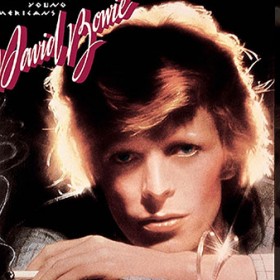
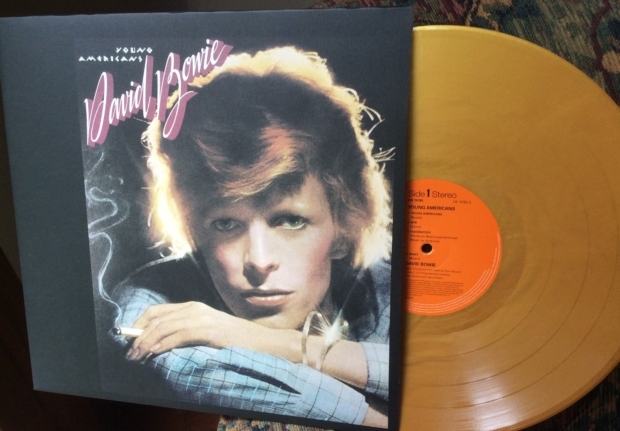
 “I was terrified of being trapped in that Ziggy Stardust character for the rest of my career,” David Bowie solemnly confessed to me In the Studio. So in early March 1975, Bowie executed a musical and visual image hard left turn, in homage to the vibrant soul music with which he had fallen in love while living in New York City then. The resulting albumYoung Americans contained the sweeping “Win”; the soulful “Somebody Up There Likes Me”, featuring the budding sax star David Sanborn (d. 2024) steaming like a Junior Walker acolyte; the huge hit with the John Lennon cameo, “Fame”; and the dance-floor flooding “Young Americans”. The late David Bowie from the In the Studio classic rock interview archives marks the all-important career landmark Young Americans.
By 1975 David Bowie had abandoned the Glam Rock he had virtually invented in the guise of the ego-tripping tragicomic fallen rock star Ziggy Stardust, first as New York City blue-eyed soul man, then the LA decadence of his Thin White Duke persona. David Bowie was rock’s Full Moon, irresistible in his pulling power, while the rest of the rock world was like the tide, following inexorably yet always lagging behind. But with Bowie’s mid-decade Young Americans album with the #1 hit “Fame” and its John Lennon cameo pointing directly toward Disco’s dominance a mere two years later, hindsight clearly shows that the tide was rising quickly. 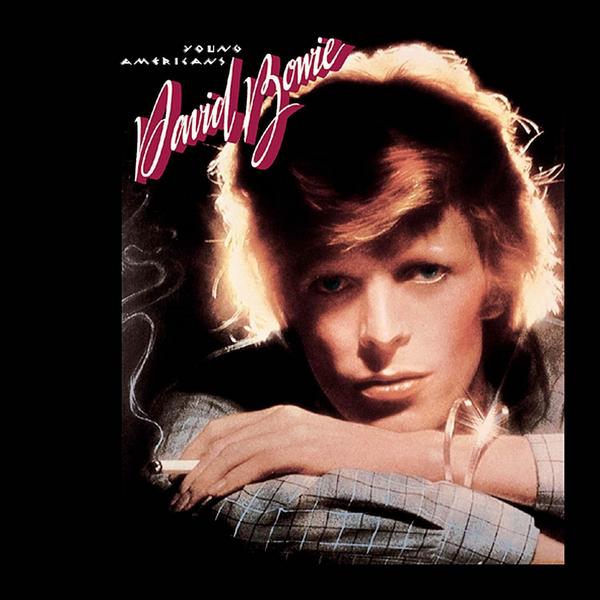
Arguably, the sound of the Seventies may have dawned as early as August 1971 with Who’s Next, or as late as April 1973 with Dark Side of the Moon. But with David Bowie’s June 1972 The Rise and Fall of Ziggy Stardust and the Spiders from Mars, not only did the exaggerated stereo and dry close-miked perspective make the sound of The Spiders seem to threaten to pierce the invisible barrier of your speakers, but Bowie’s hair, makeup, cross-dressing, and outrageous onstage behavior looked and acted like nothing we’d ever seen outside of a Frederico Fellini film festival. David Bowie took my assessment of the Seventies’ line of demarcation one better: “The Seventies really felt like a new century. The Sixties were a coda to the rest of the (20th) Century,” David stressed. “I think the Seventies showed conclusively that we live on a thread of rationality, that in fact the cosmos is far more complex and non-understandable than we had perceived. That everything we know is WRONG!” –Redbeard