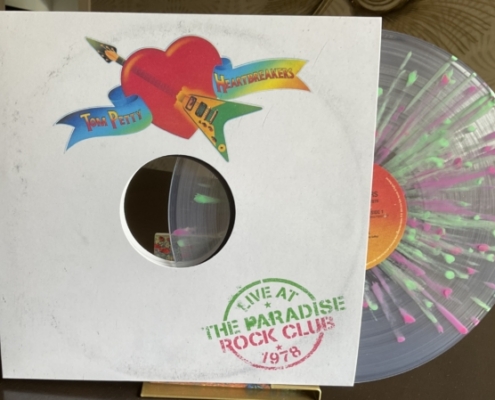
When Tom Petty and the Heartbreakers only had two albums of material from which to draw for their club sets (which often meant several sets a night), the band would reach down at just the right time and throw a change up cover song such as “Don’t Bring Me Down” that would shift the set into another gear. As their career evolved and Tom and Mike Campbell’s prolific songwriting made that option less and less of a necessity, it was gratifying to see Petty and the Heartbreakers continue to embrace the rich rock’n’roll canon passionately and perform these chestnuts without any hint of self-conscious like many of their peers.
This performance from The Paradise Club in Boston in 1978 serves as homage, not only to Eric Burden and the Animals who popularized it originally, but also to composers Carole King and the late Gerry Goffin. –Redbeard
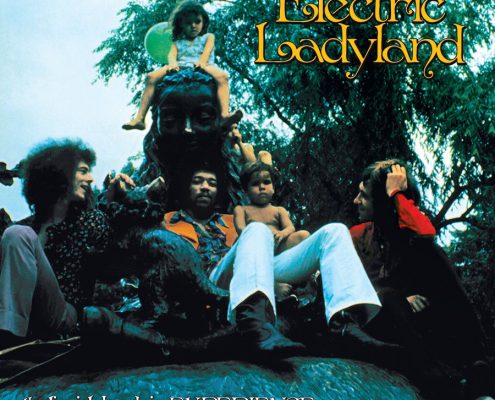
Jimi Hendrix and his British trio the Experience created a landmark double album in 1968 called Electric Ladyland, but now this deep into the 21st century it may be difficult for many to fully understand the context in which it was made and the world into which it was subsequently released. When Hendrix had been “discovered” by Animals bass player Chas Chandler only two years earlier in a New York City Greenwich Village club on the equivalent of “open mic night”, Jimi was fresh off the chitlin circuit purely as an anonymous sideman. After relocating to London with the veteran Chandler as mentor/co-manager/producer, Hendrix released two game-changing albums before returning back to America.
But as you will hear in the conclusion of this classic rock interview with biographer/ reissue producer John McDermott plus one of the last interviews with Jimi Hendrix Experience drummer Mitch Mitchell, neither Chandler nor Experience bass player Noel Redding were on board with the change. Hendrix’s joy to be back is apparent in his embrace of many formative musical influences including soul, rhythm and blues, and jazz, but the fact that the April 1968 assassination of the leader of the American civil rights movement, the Rev. Dr.Martin Luther King jr, which had touched off violent race riots across many major U.S. cities, shattered any naivete that here was an African-American leading an otherwise all white band on tour across the U.S., including the heavily segregated South, during the most violent year in America since World War II. –Redbeard
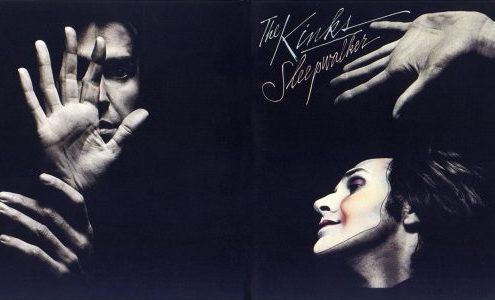
The Kinks were probably a lock for Rock and Roll Hall of Fame induction for their British Invasion Sixties output alone. But then the first half of the Seventies was tough sledding for them until reclaiming their rock bona fides, starting with February 1977’s Sleepwalker, the Kinks’ sixteenth (!!) studio album, and much of what turned up on 1978’s Misfits. The Kinks’ leader and poet laureate of rock, Sir Raymond Douglas Davies, joins me In the Studio for the stories behind “Juke Box Music”,”Sleepwalker”,”Live Life”, “Rock and Roll Fantasy” (the best Ray Davies ballad since “Celluloid Heroes”), and the title song on Misfits.
Historically lumped into the mid-Sixties British Invasion bands with The Beatles, Rolling Stones, and The Who, London’s lovable Kinks nevertheless took a considerably different, albeit unintended, path into the Seventies, particularly in America. At the era-defining iconic rock events from 1967 to 1977…Monterey Pop Festival, Woodstock, Altamont, Isle of Wight Festivals, Watkins Glen, Day on the Green…where were The Kinks?
Inexplicably, this band who had reeled off a string of Top Ten hits in both the UK and US with “You Really Got Me”,”All Day and All of the Night”,”Tired of Waiting for You”,”Sunny Afternoon”,”Victoria”,”Apeman”, and the timeless “Lola“, all which had helped to define rock’n’roll on radio in the latter half of the Sixties, went MIA there, seemingly sleepwalking through much of the Seventies. But it certainly was not for lack of trying. The exquisite “Celluloid Heroes” appeared on The Kinks’ 1972 album Everybody’s in Showbiz, yet still had disappointing US sales. Ray Davies then wrote a series of musical shows, including 1973’s Preservation Act 1 (a double album, no less); Preservation Act 2 followed a year later; and Soap Opera bubbled up in 1975. Not a one broke into the US Top Fifty sales.
When the opportunity to record for veteran record man Clive Davis’ Arista label appeared in 1976, it came with a corporate caveat: no concept albums. Songs including “Sleepwalker” and “Juke Box Music”, with Ray Davies giving the good-natured nod to critics who felt that his preceding five year output had been too precious for rock’n’roll, helped to put The Kinks back on influential US rock radio in 1977, which in turn permitted them to headline major US arenas for the first time. The momentum continued into the legendary band’s Misfits in early Summer 1978. –Redbeard
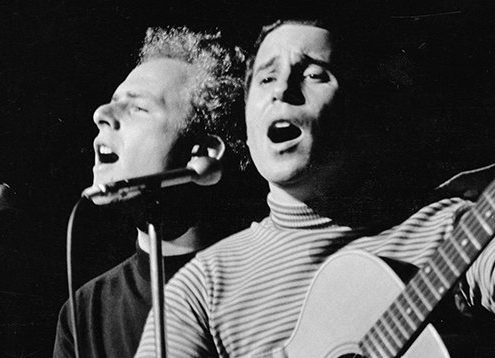
June 16-17-18 was the anniversary of the Monterey Pop Festival which, more than anything else, crystallized in many people’s minds the Summer of Love in 1967. Besides memorable performances by established hitmakers of the day the Mamas and Papas, Simon and Garfunkel, The Who, Buffalo Springfield, Otis Redding, and the Jefferson Airplane, Monterey Pop was the debutante coming out party for a singer from Beaumont Texas by way of San Francisco named Janis Joplin, and an African-American from Seattle named Jimi Hendrix. The electric guitarist had just arrived back in the States from London prior to the release of their first album with his trio, The Jimi Hendrix Experience, and would burn up the Monterey Pop stage- literally. The Monterey Pop Festival was organized by John Phillips (of the Mamas and Papas), their record producer Lou Adler, and by New York City-based Paul Simon and Art Garfunkel, the latter of whom fifty years on shared these memories and some illuminating cultural and social observations with me In The Studio. – Redbeard