
Tag: best selling albums 1975

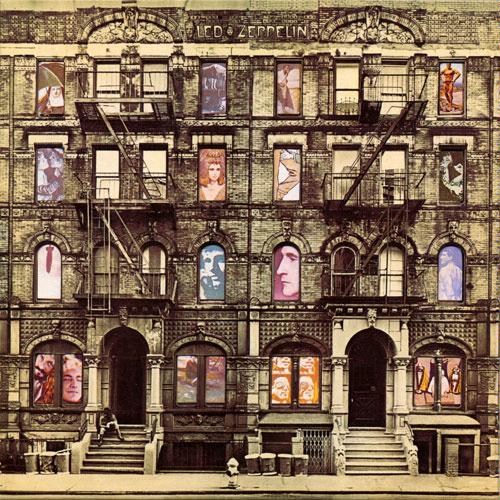
  • Led Zeppelin- Physical Graffiti- Jimmy Page
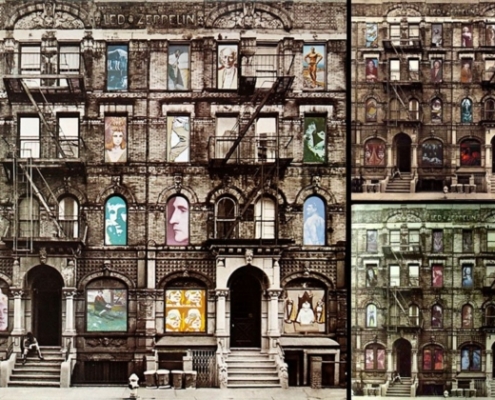
    Led Zeppelin- Physical Graffiti- Jimmy Page

    By the time of its late February 1975 release, Led Zeppelin’s sixth album Physical Graffiti signaled a fundamental change in the popular music and media equation that began with  IV .  With “Stairway to Heaven” Led Zeppelin had proven that the album format had matured to the point that a hit single for Top 40 radio was no longer a necessity for huge album sales in America. By the time of recording the wide variety of styles for Physical Graffiti‘s  four sides, a hit single wasn’t even a consideration for Page, lead singer/lyricist Robert Plant, bass playing multi-instrumentalist John Paul Jones, and legendary drummer John Bonham.

    In the delightful 2008 electric guitar documentary film It Might Get Loud  starring Led Zeppelin founder Jimmy Page along with The Edge from U2 and Jack White, we finally get a glimpse inside the English country manor house known as Headley Grange,  immortalized as the site of recording Led Zeppelin’s record-breaking  sixth album  Physical Graffiti. Clearly, in the film Page cannot contain his pleasure with returning to the scene of creating that iconic fourth Led Zeppelin recording, as well as what would become the inspired double album Physical Graffiti   three years later.
    To reissue this 16X platinum ( ! ) magnum opus, producer/ co-writer Jimmy Page meticulously remastered the bounty of songs on the original and combined them with unheard demos, roughs, and working versions from the Physical Graffiti sessions for a truly deluxe edition worthy of the term. In my classic rock interview for part one, Jimbo lifts the curtain on the rapier “Custard Pie”, the funky romp”Trampled Underfoot”, the thunderous grind of “The Rover”, the acoustic toe-tapper “Black Country Woman”, and the whisper-to-a-scream dynamic eleven minute ecstasy of “In My Time of Dying”. Jimmy Page joins me as very special guest for the first of our two-part exploration of the album Rolling Stone magazine ranks at #70 on their ” Top 500 Albums of All Time”. –Redbeard

  • Led Zeppelin- Physical Graffiti pt2- Robert Plant, Jimmy Page
    Led Zeppelin- Physical Graffiti pt2- Robert Plant, Jimmy Page

    Fifty years on, Led Zeppelin’s 1975 double album Physical Graffiti‘s sonic slam has not diminished one iota in strength, sheer number of exceptional songs, the band at peak performance, and Jimmy Page’s impeccable production. Funky “Custard Pie”, “The Rover”, the furious “In My Time of Dying”, the playful “Houses of the Holy”, funky electricity of “Trampled Underfoot”, and epic synth/French horn arrangement of “Kashmir” can still leave the listener breathless five decades later…and that’s just the halfway mark.

    “Traveling the world was now a constant thing…The whole thing was becoming a creative process,” Led Zeppelin’s Jimmy Page said  at a press conference, reminiscing about the February 1975 double album  Physical Graffiti . By the time of composing for this, their sixth studio album, Led Zeppelin’s international success was taking their tours to far-flung places in the world, which in turn exposed the band to even more creative stimuli. For instance, a distinct new flavor had already started to spice up the blues-based hard rock on certain songs on the preceding Houses of the Holy : Jimmy Page’s staccato guitar was locking in far more often with John Bonham’s inventive percussion in a choppy rhythmic manner, which in turn left space for multi-instrumentalist John Paul Jones to fill with a new instrument, the electric clavinet.
    LED-ROBT-935939_10200327575093923_1720918598_nIn the recording, the daunting challenge of capturing the sheer scale of Led Zeppelin’s sonic dynamics was never so successfully rendered by Jimmy Page in the producer’s role, without overwhelming the recording process of the day nor compromising the visceral impact of this double album. Here in the conclusion of my interview, Page discusses the grandeur of “Kashmir”, the progressive rock of “In the Light”, the furious electric funk of “The Wanton Song”, and the shimmering delicacy of “Ten Years Gone”. Inside Robert Plant ( r ) explains the elusive motivational sparks which were responsible then for Physical Graffiti  brilliance which has accounted for sales of over sixteen times platinum.

    LED-JIMMY-PAGE-720x405-458901406Listen to Jimmy Page (l) and Robert Plant In the Studio for the conclusion of the Physical  Graffiti  deluxe edition. – Redbeard 

  • Eagles- On the Border- the late Glenn Frey & Randy Meisner

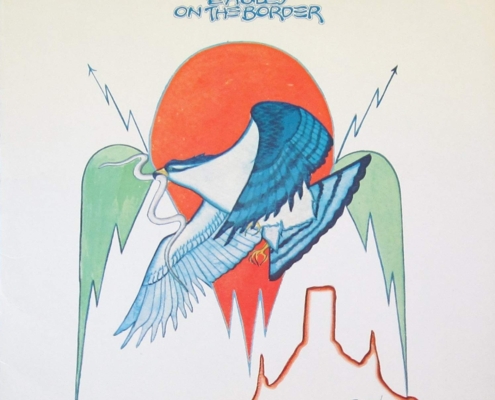
    Eagles- On the Border- the late Glenn Frey & Randy Meisner

    It’s odd, but until preparing this interview about The Eagles‘ second and third albums Desperado and On the Border, released in 1973 and 1974 respectively, I had not really noticed how little each Eagles album sounded like its predecessor. For a possible explanation as to how that might be the case, we tapped the In the Studio interview archive for the insights of two original Eagles bandmates, co-founding singer/songwriter/guitarist Glenn Frey and original bass player/singer/songwriter Randy Meisner, both now gone.

    Like the first two Eagles efforts, On the Border was begun in London England and supervised by veteran English producer Glynnis Johns. But those sessions only yielded two usable recordings. Glenn Frey was so at odds with producer Johns that one of the two salvaged songs, “Best of My Love”, was sequenced dead last when the album was released, buried on side two as if to hide the pain. Neverthelss, through a quirk of fate, Frey reveals how “Best of My Love” became The Eagles’ first #1 hit, eventually propelling the On the Border album to over two million sales.

    The dedication to songcraft on Desperado, which is evident from the first note of “Doolin Dalton”, on through “Tequila Sunrise”, “Certain Kind of Fool”, “Outlaw Man”, “Bitter Creek”, and the timeless “Desperado”, would later bear bountiful fruit for Frey, Meisner, Don Henley, and Bernie Leadon on the Eagles’ 1975 #1-selling One of These Nights. That effort was their first album to soar that high, a cosmopolitan country/ R&B hybrid that generated three Top 10 hits and effectively founded uptown Modern Country music as we now know it, fundamentally changing the course of contemporary music. Hotel California in 1976 and The Long Run  in 1979 closed out the Seventies in colossal fashion for the Eagles, whose popularity remained undiminished deep into the 21st Century.

    (Playing possum L-R: Bernie Leadon, Glenn Frey, Randy Meisner, Don Henley, J.D. Souther)

    But in this interview Glenn Frey waved off the initial success of the first Eagles album to the songs of Jackson Browne, Jack Tempchin, and beginner’s luck, and placed the later record-setting success of The Eagles hinging on his 1973 decision, along with band co-founder Don Henley and songwriters Browne and J.D. Souther, to write a cinematic “cowboy concept” album. Heavily researched and historically accurate, the Eagles’ second album Desperado was recorded, arranged, and orchestrated in London, topped off back in Hollywood with tintype photography and period clothing for the cover, and even a guns-blazing promotional video a decade before MTV that would have made Quentin Tarantino envious. So did their handlers like what The Eagles had hatched on Desperado ?
    “(Co-managers) David Geffen and Elliot Roberts were really kind of against it, in a lot of ways”, admitted original Eagles bass player/singer/songwriter Randy Meisner, “because they didn’t like it after we’d finished it. It wasn’t the kind of album you’d think we should have had for the second album. They thought it should be more down the line of the first album with more rock’n’roll songs, and it shouldn’t be a theme album. That it was chancey, that it was a big chance to take.”

    Until the day that he died in January 2016, Eagles co-founder Glenn Frey was exceedingly proud of  their second album, 1973’s Desperado. But Desperado did not have three Top 20 hits like the Eagles debut, nor did it contain the Eagles’ first #1,”Best of My Love”, that distinction belonging to 1974’s On the Border  album released fifty years ago in March 1974. Purely in popularity and chart stats, that sophomore record had the lowest glide path of any Eagles effort, yet in this exclusive In the Studio  interview, Frey and original Eagles bass player/singer/songwriter Randy Meisner make a detailed case  for why Desperado  may be their most formative one of all.

    On the Border is also notable for an eleventh hour personnel addition, Don Felder on lead guitar, and Randy Meisner is quick to note that Felder was, in fact, suggested by Eagles guitarist Bernie Leadon from their earlier Florida days. Songs include “James Dean”, “Already Gone”, the Tom Waits chestnut “Old ’55”, “Best of My Love”, and the title song, “On the Border” hosted by the sincerely missed Glenn Frey and the dearly departed Randy Meisner for the fiftieth anniversary of The Eagles’ On the Border. –Redbeard