Tag: best selling albums 1975

  • The Outlaws- Ghost Riders 45th- Henry Paul, the late Hughie Thomasson

    The Outlaws- Ghost Riders 45th- Henry Paul, the late Hughie Thomasson

    With the forty-fifth anniversary of Ghost Riders by The Outlaws, a flood of personal memories have surfaced.”The ‘Burning of Bowling Green’,” Outlaws singer/songwriter/rhythm guitarist Henry Paul recalled aloud, invoking an almost mythical status like some Civil War battlefield to the 1975 Ohio music festival where we first met just weeks after the release of their first album, The Outlaws (#13 Billboard), in July 1975. It contained the late Hughie Thomasson and Monte Yoho’s “There Goes Another Love Song” and the instant Southern Rock classic “Green Grass and High Tides”.

    Riding to early gigs packed into the old metallic-painted windowless band van nicknamed “The Copper Coffin”, Tampa Bay’s The Outlaws risked life and limb to follow their collective dream. Fifty years ago legendary record executive Clive Davis, who had signed Bob Dylan, Janis Joplin, and Bruce Springsteen to his former label, introduced his new New York City-based record company, Arista, with a three guitar Southern Rock band’s debut album, The Outlaws. With the Allman Brothers Band forming in Daytona Beach and Lynyrd Skynyrd from the wrong side of Jacksonville, the state of Florida was Southern Rock Central in the mid-1970s, so any Stetson-wearing guitar-picking long-haired rock band in those parts  was graded on a mighty steep curve. Such was the case for The Outlaws from Tampa Bay who, like 38 Special and later Molly Hatchet, were second generation Southern rockers. The Outlaws combined the guitar army assault of their Lynyrd Skynyrd mentors with the stacked vocal harmonies of the Eagles on their July 1975 debut featuring “There Goes Another Love Song” and the instant anthem “Green Grass and High Tides”; “Gunsmoke” and “Hurry Sundown” from their strong 1977 concept album Hurry Sundown. Then there was the scintillating stratospheric vocal chorus of “You Are the Show”; and the galloping production showstopper “Ghost Riders in the Sky”. Henry Paul and the late Hughie Thomasson, the only musician to perform on every Outlaws album, joined me In the Studio for this classic rock interview marking the forty-fifth anniversary of Ghost Riders in what sadly turned out to be Hughie’s final one. –Redbeard

  • Queen- A Night at the Opera @50- Brian May, Roger Taylor

    Queen- A Night at the Opera @50- Brian May, Roger Taylor

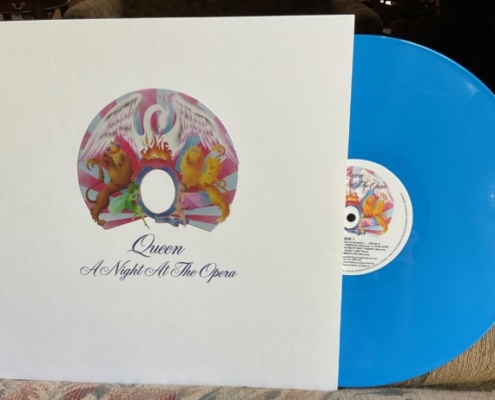
    Life’s big breaks don’t come with an engraved invitation, yet Queen’s big star-making effort A Night at the Opera actually did, right there on the album cover in November 1975. But it is a miracle that Queen ever got the chance. Already one album past their initial three-album deal with their record company, the London four-piece had  only a couple of  hits to show for their effort and expense in the UK, but only a single mid-chart success in the States with “Killer Queen” in 1974. Their first US tour supporting Mott the Hoople ended abruptly when Queen guitarist Brian May contracted hepatitis, only to then have emergency surgery for life-threatening ulcerated impacted intestines. The band was more than $100,000 in debt, while all earnings from record sales and concerts “mysteriously disappeared about the time our first manager sported a new swimming pool and Rolls-Royce”, as Queen drummer Roger Taylor told me here In the Studio.

    It would be next to impossible to overstate the importance of Queen’s  1975 fourth effort,  A Night at the Opera, both to the band’s career and to the album’s influence on rock thereafter. There has never been a day in the last fifty years when some American radio station has not played “Bohemian Rhapsody” from Queen’s fourth album A Night at the Opera. And who can forget the car radio scene immortalizing the ubiquitous response in Wayne’s World? But none of this universal acclaim can begin to explain  just how close the London-based quartet came to being dropped from their record label and drowning in debt five decades ago.
    Brian May, one of the finest guitarists in rock history (and one of the sweetest souls ever) is joined again In The Studio by Queen drummer Roger Taylor in my classic rock interview for  this eclectic mix of hard rock (“Death on Two Legs”, “I’m in Love With My Car”), progressive rock (“The Prophet Song”), skiffle pub sci-fi singalong (” ’39”), mainstream pop (“You’re My Best Friend”), campy vaudeville (“Lazing on a Sunday Afternoon”), drop dead gorgeous love song (Freddie Mercury’s “Love of My Life”), and mock operetta (“Bohemian Rhapsody”) on Queen A Night at the Opera golden anniversary.  -Redbeard

  • Marshall Tucker Band- Searchin’ for a Rainbow- Doug Gray, the late Jerry Eubanks
    Marshall Tucker Band- Searchin’ for a Rainbow- Doug Gray, the late Jerry Eubanks

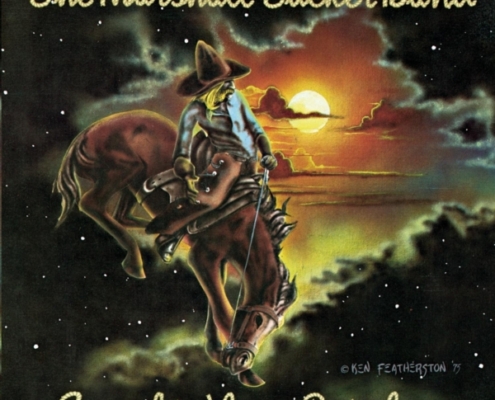
    Lightning round quick question: after the Allman Brothers Band, which recording artists sold the most records on Southern Rock pioneer Phil Walden’s Capricorn Records? That distinction belongs to the band built around guitar-playing brothers Toy and Tommy Caldwell of Spartanburg South Carolina and their childhood chums in the Marshall Tucker Band. Lead guitarist Toy Caldwell had a jazz-tinged nimbleness in his fluid solos which he played with his thumb, which no doubt was informed by Western Swing and accented by reed man Jerry Eubanks on sax and flute. George McCorkle provided  rhythm guitar and a few great songs, too, while Tommy Caldwell anchored the bottom on bass, Paul Riddle on drums, and soulful Doug Gray lent a powerful set of lungs.

    In the 50th anniversary  of  Marshall Tucker Band’s August 1975 sweet fourth album Searchin’ for a Rainbow, a Top 15 seller on Billboard, we feature singer Doug Gray and the late reed player Jerry Eubanks telling charming stories while surrounded by “Take the Highway” and “Can’t You See” (sung by Toy Caldwell ) from MTB’s 1973 debut; a scorching live performance of “24 Hours at a Time” with Charlie Daniels on fiddle; the late guitarist George McCorkle’s “Fire on the Mountain”,”Virginia”, and “Searchin’ for a Rainbow”; and “Heard It in a Love Song” which made Carolina Dreams their highest charting single and album.
    Doug and Jerry speak wistfully in my classic rock interview about the times before a tragic accident took Tommy Caldwell in 1980, as well as the untimely passing of big brother Toy at age 44 in 1993. But do not miss the poem which Charlie Daniels wrote in tribute to Tommy Caldwell and shared  during my interview on July 4, 1980 on ROCK 103 in Memphis just weeks after Tommy’s funeral, which incorporates several Marshall Tucker Band song titles. For more, be sure to listen to In the Studio‘s two-part The History of Southern Rock.

    This episode dedicated to the late reed player Jerry Eubanks. -Redbeard

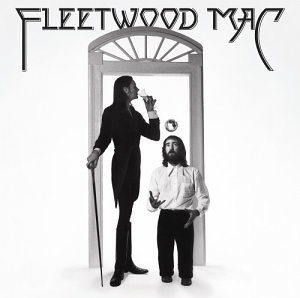
  • Fleetwood Mac- White Album 50th- Stevie Nicks, Mick Fleetwood

    Fleetwood Mac- White Album 50th- Stevie Nicks, Mick Fleetwood

    After Bob Welch left Fleetwood Mac, his first solo album in the Fall 1975 came and went in about 15 minutes, not unlike the 1973 Buckingham Nicks album, which was the sole recorded output of Welch’s replacements, singer/guitarist Lindsey Buckingham and singer/songwriter Stephanie “Stevie” Nicks. So on balance I didn’t see how this major change could do anything except diminish Fleetwood Mac.
    Boy, was I wrong! That 1975 Fleetwood Mac album sold over twenty times as many copies as any previous Fleetwood Mac album. But the unsung hero is actually producer/recording engineer Keith Olsen, who had produced and recorded the Buckingham Nicks album, imparting a fat, warm, upfront sound to their music. It was in that context that bandleader Mick Fleetwood first noticed Lindsey Buckingham’s guitar playing and singing abilities, but at the time it was Keith Olsen’s studio and recording techniques that Mick was auditioning, not the musicians. When Fleetwood fell in love with the sound that he heard, he wisely decided to embrace all of it – the musicians Buckingham and Nicks, the producer Keith Olsen, the Sound City studio – and incorporate it all into the next Fleetwood Mac album, which featured “Monday Morning”,”Over My Head”,”Say You Love Me”,”Rhiannon”,”Crystal”, and “Landslide”. Not only did that decision change the fortunes of all involved, it would also change the sound of contemporary music for years to follow. Stevie Nicks, Mick Fleetwood, and former member Lindsey Buckingham all share their recollections with me in great detail in this classic rock interview In the Studio on the golden anniversary of Fleetwood Mac’s “White Album”. –Redbeard

  • James Taylor- Gorilla 50th Anniversary

    James Taylor- Gorilla 50th Anniversary

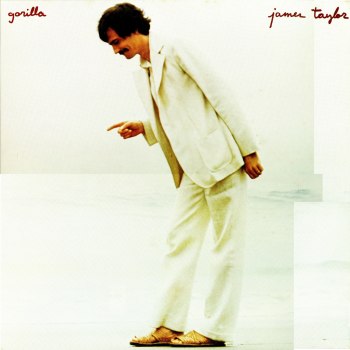
    By the time James Taylor released his sixth studio album Gorilla in May 1975, the popularity of the post-Dylan acoustic singer/songwriter balladeer style which he had led was receding rapidly in the rearview mirror. For Gorilla, the approach was to augment Taylor’s strong collection of songs with an “uptown” LA session band and support James’ vocals with the heavenly harmonies of the all-star vocal section of David Crosby, Graham Nash, and paramour Carly Simon. The results were Top Six Billboard album sales for Gorilla.

    The album sales were driven by two big hits, JT’s own “Mexico” and a finger poppin’ cover of Marvin Gaye’s Motown hit “How Sweet It is to Be Loved By You”, the latter spotlighting saxophonist the late David Sanborn who, having been featured a year earlier on David Bowie’s Young Americans album and tour, was about to launch his own solo career in the Fall 1975. Also, Little Feat slide guitarist Lowell George‘s distinctive whine provides just the right atmosphere like some electric mosquito on “Angry Blues”. James Taylor is my guest here In the Studio as we mark the golden anniversary of Gorilla. – Redbeard

  • Doobie Brothers- What Were Once Vices…/Stampede- Tom Johnston, Pat Simmons
    Doobie Brothers- What Were Once Vices…/Stampede- Tom Johnston, Pat Simmons

    Even a half-century after its April 1975 release, the two things I recall most about Stampede, the fifth album from San Jose’s Doobie Brothers, was the duality evident in the band’s emerging sound. There was the noticeable sophistication in the sweeping symphonic arrangements by concert master Nick DeCaro, embellishing Pat Simmons’ ostensibly acoustic ballad “I Cheat he Hangman”, but in stark contrast to the Doobie Brothers’ big hit with the Motown cover of “Take Me in Your Arms (Rock Me for a Little While)”. Meanwhile, the Doobie Brothers’ brutal non-stop touring schedule then was about to move multiple original members from Injured Reserve to the Disabled List, including singer/songwriter/frontman guitarist Tom Johnston.

    By the time the Doobie Brothers’ fourth album, What Were Once Vices are Now Habits, was released in early 1974, their third, The Captain and Me  a year earlier had proven that 1972’s Toulouse Street  and the hit “Listen to the Music” were no flukes. The Doobie Brothers went from playing bars around their native San Jose and San Francisco Bay Area to theaters and small halls across America. “Another Park, Another Sunday” was chosen by the band’s record company as the first single from Vices…/Habits, but it stalled at only #32. Despite the seemingly unstoppable groove of the next single choice, “Eyes of Silver”, featuring the infectious soul of the Memphis horns, that single failed to even make  it past #52. Then a remarkable thing happened:  an album track from …Vices/…Habits  received considerable airplay on the  progressive rock FM radio stations which were growing in popularity. Never intended by the Doobie Brothers’ record company to be a single ( it had been the “B” side to “Another Park, Another Sunday” eight months earlier, in fact), “Black Water” revived the dismal sales picture, becoming the band’s first #1 song and eventually selling over one million copies of What Were Once Vices…Habits.

    In April 1975 the Doobie Brothers released their fifth album, Stampede, a Top 5 seller containing Pat Simmons’ epic “I Cheat the Hangman” and the dance floor favorite Motown cover, “Take Me in Your Arms (Rock Me a Little While)”, which just grazed the Top 10. Simmons and Doobie Brothers prodigal son Tom Johnston join me In the Studio in this classic rock interview. Patrick Simmons, singer/songwriter/ guitarist and the only musician to appear on every Doobie Brothers album and tour in their fifty-five year career, told me in this classic rock interview, “For us at that time, we were just plain lucky.” The surprise success from “Black Water” afforded the band some creative license on their next album, Stampede,  released in April 1975. There is the Jack Kerouac On the Road -themed “Neal’s Fandango”; the sweeping energetic take on the Holland-Dozier-Holland songwriting juggernaut’s Motown hit for Kim Weston, “Take Me in Your Arms (Rock Me for a Little While )”, which made it to #11 for the Doobie Brothers; and several big name guest musicians helping to make Stampede the best sounding Doobies album to date. But as you will hear from Simmons, Johnston, and the late Doobie drummer Mike Hossack, the non-stop grind of five years of one-nighters, stopping only long enough to record the next album, was starting to create stress fractures in the foundation of the band which  would sideline Tom Johnston with a bleeding ulcer and, ultimately, alter the sound of the Doobie Brothers for the next decade. –Redbeard

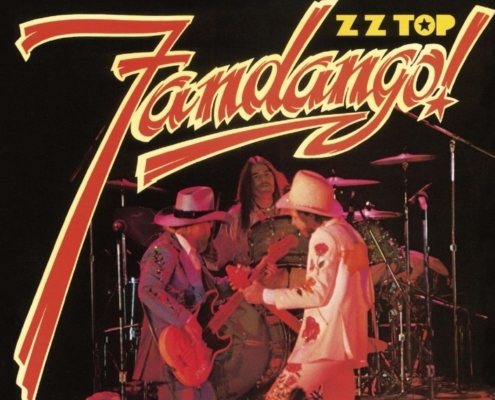
  • ZZ Top- Fandango 50th- Billy Gibbons, Dusty Hill, Frank Beard

    ZZ Top- Fandango 50th- Billy Gibbons, Dusty Hill, Frank Beard

    “The first time we played there, the roof blew off!” drawls ZZ Top singer/guitarist Billy Gibbons, recalling the New Orleans nightclub The Warehouse, scene of the live side of their April 1975 album Fandango!. “A hurricane came through New Orleans and tore the roof off of the place.”
    “Yeah, we didn’t do it,” chuckled ZZ Top bass player/rave up singer Dusty Hill, who passed away Summer 2021.But each time we played The Warehouse, the crowds got more and more wild.”

    “For Christmas one year we got The Warehouse promoter, Don Fox of Beaver Productions, a three-legged beaver that got loose in the club,” drawled ZZ Top drummer Frank Beard, grinning. “And the beaver ate the stage. The stage collapsed, and The Warehouse closed forever. So I guess we’re responsible for that!”

    From this distant vantage point it is entirely understandable why ZZ Top manager/producer the late Bill Ham felt that, to capitalize on the Cinderella success of the Texas trio’s sudden unlikely breakthrough at Top 40 radio with “Lagrange” from their excellent 1973 third album Tres Hombres, the band needed to play on as many stages as Ham could book. And while writing, recording, and releasing a new album as quickly as humanly possible, both in order to maintain the newly-minted momentum. The only problem, of course, is that those two endeavors are mutually exclusive: touring is communal, public, and (if you’re popular ) non-stop, whereas writing and recording take downtime, solitude, and focus on songcraft. Thus ZZ Top’s fourth album Fandango, released in April 1975, is half live in concert and half recorded in the studio. One of our best music writers, Stephen Thomas Erlewine on AllMusic.com, says of Fandango’s live side (quote) “…these are really good live cuts…”, but at least with the original mixes and mastering, I beg to differ. Apparently so did radio programmers nationwide, because practically nobody played these live recordings on the radio. Moreover, in my almost fifty years on the air in Dallas/Ft. Worth, Memphis, New England, and the Midwest, I don’t ever recall a single audience request for anything off the live side.

    However, the studio side of Fandango  contains songs and recordings which are some of ZZ Top’s most timeless material, including “Heard It on the X”, the achingly slow tempo of “Blue Jean Blues”, the riff rocker “Nasty Dogs and Funky Kings”, and the Dusty Hill ornery shouter “Tush”. In this classic rock interview  about Fandango, my guests Billy, Dusty, and Frank in “That Little Ol’ Band from Texas” were tellin’ tall tales here In the Studio  long before ZZ Top documentaries on Netflix or Amazon Prime were ever invented.

    This edition of In the Studio is lovingly dedicated both to Dusty Hill and to longtime ZZ Top recording engineer Terry Manning, who passed suddenly March 2025. –Redbeard

  • Aerosmith- Toys in the Attic- Steven Tyler, Brad Whitford, Joey Kramer, Tom Hamilton, Joe Perry
    Aerosmith- Toys in the Attic- Steven Tyler, Brad Whitford, Joey Kramer, Tom Hamilton, Joe Perry

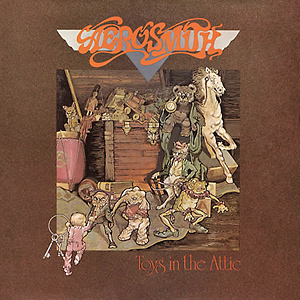
    We dust off Toys in the Attic,  the breakthrough third album for Aerosmith in  April 1975. Toys in the Attic  was the foothold  for Aerosmith to climbing the sales charts on their way to becoming America’s most popular and influential hard rock band. Containing perennial favorites “Walk This Way”,”Sweet Emotion”, the first anti-child abuse song “Uncle Salty”, the circular contagion of “No More, No More”, a swingin’ cover of Bullmoose Jackson’s bawdy “Big Ten Inch”, and the riff rock title song, Toys in the Attic  showed that my guests Steven Tyler, Brad Whitford, and Joey Kramer, along with bassist Tom Hamilton and lead guitarist Joe Perry, were not toying around.

    Contrary to what you might assume, through their first two albums Aerosmith struggled to get noticed. In this classic rock interview, Aerosmith drummer Joey Kramer reminded me that “Dream On” from their debut by then had been released as a single three times,  and flopped twice. Sure, a few of us intrepid radio deejays played it  plus by several songs  on Get Your Wings (my efforts were confirmed years later in the band’s autobiography Walk This Way  when Aerosmith noted that, outside of the Boston base, their next biggest crowds & sales circa 1973-74 were in Marion, Ohio), but Toys in the Attic changed all that in Spring 1975, eventually racking up over eight million copies sold and a ranking of #229 on Rolling Stone magazine’s Top 500 Albums of All Time list. –Redbeard
    (
    Rock stars do homework, too: L-R Alice Cooper, Mick Fleetwood, Aerosmith’s Steven Tyler, and Sammy Hagar inspect Peter Green’s original hand-written lyrics for Fleetwood Mac’s “Rattlesnake Shake”)

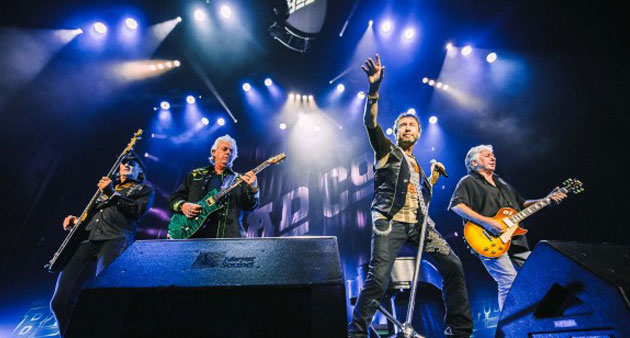
  • Bad Company- Shooting Star- Dallas/Ft.Worth 7-10-13
    Bad Company- Shooting Star- Dallas/Ft.Worth 7-10-13

    Bad Company really impressed on their Summer 2013 40th Anniversary Tour and here is irrefutable evidence, as this live performance of “Shooting Star” originally found on their March 1975 second album, Straight Shooter, came straight off the concert mixing console the night of July 10, 2013 in Dallas/ Ft.Worth (Grand Prairie) Texas! – Redbeard

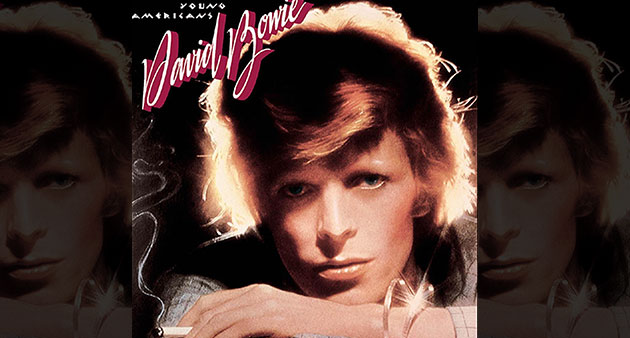
  • David Bowie- Young Americans

    David Bowie- Young Americans

    “I was terrified of being trapped in that Ziggy Stardust character for the rest of my career,” David Bowie solemnly confessed to me In the Studio. So in early March 1975, Bowie executed a musical and visual image hard left turn, in homage to the vibrant soul music with which he had fallen in love while living in New York City then. The resulting albumYoung Americans contained the sweeping “Win”; the soulful “Somebody Up There Likes Me”, featuring the budding sax star David Sanborn (d. 2024) steaming like a Junior Walker acolyte; the huge hit with the John Lennon cameo, “Fame”; and the dance-floor flooding “Young Americans”. The late David Bowie from the In the Studio  classic rock interview archives marks the all-important career landmark Young Americans.

    By 1975 David Bowie had abandoned the Glam Rock he had virtually invented in the guise of the ego-tripping tragicomic fallen rock star Ziggy Stardust, first as New York City blue-eyed soul man, then the LA decadence of his Thin White Duke persona. David Bowie was rock’s Full Moon, irresistible in his pulling power, while the rest of the rock world was like the tide, following inexorably yet always lagging behind. But with Bowie’s mid-decade Young Americans  album with the #1 hit “Fame” and its John Lennon cameo pointing directly toward Disco’s dominance a mere two years later, hindsight clearly shows that the tide was rising quickly.

    Arguably, the sound of the Seventies may have dawned as early as August 1971 with Who’s Next,  or as late as April 1973 with Dark Side of the Moon. But with David Bowie’s June 1972 The Rise and Fall of Ziggy Stardust and the Spiders from Mars, not only did the exaggerated stereo and dry close-miked perspective make the sound of The Spiders seem to threaten to pierce the invisible barrier of your speakers, but Bowie’s hair, makeup, cross-dressing, and outrageous onstage behavior looked and acted like nothing we’d ever seen outside of a Frederico Fellini film festival. David Bowie took my assessment of the Seventies’ line of demarcation one better: “The Seventies really felt like a new century. The Sixties were a coda to the rest of the (20th) Century,” David stressed. “I think the Seventies showed conclusively that we live on a thread of rationality, that in fact the cosmos is far more complex and non-understandable than we had perceived. That everything we know is WRONG!” –Redbeard