One thing is incontrovertible about Pink Floyd: their collective creative imagination has always innovated, and usually in a very big way. Such was Pink Floyd’s decision to debut their Division Bell album, seven years in the making, live on hundreds of North American radio stations from Joe Robbie Stadium in Miami opening night on their massive sixty-date tour, in front of sixty-three thousand fans!
Part one of the live satellite broadcast is above, the conclusion is below in part two.
Thanks to Pink Floyd superfan Christopher Neely for the inspiration to post it after more than thirty years. –Redbeard
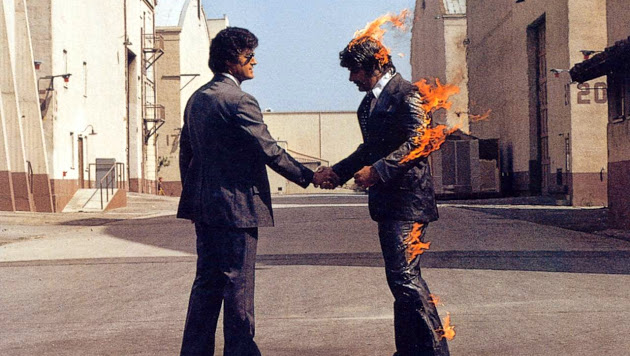
It didn’t take long for progressive rock masterpiece Dark Side of the Moon‘s worldwide success to affect the individual members and the band collective in Pink Floyd, and their followup in September 1975, Wish You Were Here, reflected a fond farewell to both long-gone Pink Floyd co-founder Syd Barrett as well as their innocence.
“YOU try following up Dark Side of the Moon. Go on, just try it!” playfully admonishes Pink Floyd guitarist/singer David Gilmour.”We’ve been trying to do it ever since,” laughs drummer Nick Mason. Yet not only is that follow up album Wish You Were Here their confessed favorite of all that they did, this postcard from the edge of Pink Floyd founder Syd Barrett’s madness holds up exceedingly well because of classics “Shine On You Crazy Diamond”,”Have a Cigar”,”Welcome to the Machine”, and the title ode.
There’s a common misconception that the fracturing of Pink Floyd occurred at some time after their worldwide blockbuster The Wall album and movie. However, this week’s classic rock interview with Waters, Gilmour, Mason, and the late Richard “Rick” Wright clearly reveals that Waters has a completely different recollection than the other three of the 1975 recording sessions for Wish You Were Here, with Waters declaring to me pithily, “That album should have been called ‘Wish WE Were Here’, because we weren’t, really. Already the rot had set in…”
Regardless of the conflicting perceptions by the participants, Rolling Stone magazine ranks Wish You Were Here at #211 on their Top 500 Albums of All Time, with readers to Britain’s Q magazine voting it much higher at#34 all time. Even prior to the reissue and box set in 2011, Pink Floyd’s ninth album had sold in excess of 13,000,000 copies. David Gilmour and Nick Mason are my guests, Roger Waters makes a cameo, and we include archive comments from the late keyboard player Richard Wright to round out the definitive classic rock interview regarding Wish You Were Here. –Redbeard
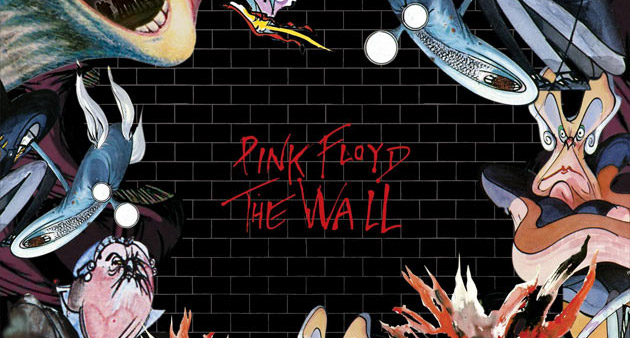
Whether architectural student-turned-musician/composer Roger Waters would have designed an actual structure more acclaimed or lucrative than The Wall, his musical concept for the Pink Floyd November 1979 double album, is pure conjecture, but the numbers that it has generated are starting to rival the Great Wall of China: #129 ranking on Rolling Stone magazine’s 2020 Top 500 Albums of All Time; worldwide sales of an estimated 30,000,000; a historic performance, broadcast and film at the actual Berlin Wall in 1990 by Waters and guest stars; a multi-year multi-continent extended live concert production of The Wall by Roger Waters, and most recently his politically-charged Us + Them tour.
Waters talks about the original Pink Floyd album, the limited initial live performances in late 1979 and early 1980, and The Wall film which followed three years after the album, with pre-Live Aid organizer and Boomtown Rats singer Bob Geldof as the disillusioned, increasingly isolated “Pink”. David Gilmour and Nick Mason also disassemble The Wall pt2 in my classic rock interview here. – Redbeard
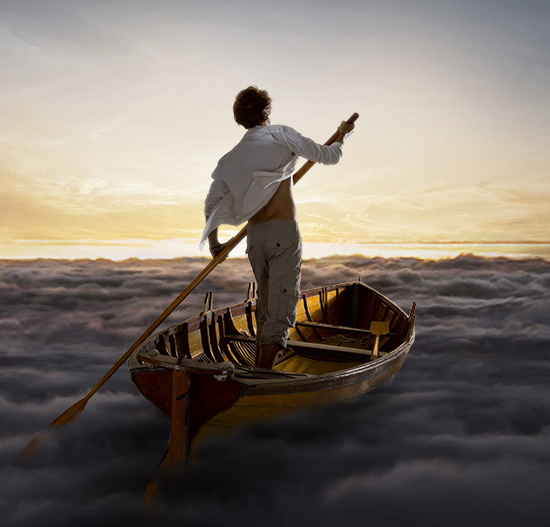
My revelatory interviews with David Gilmour and Nick Mason aboard Pink Floyd’s floating studio on the Thames River in 2014 were regarding the surprise album so far of the 21st century, Pink Floyd’s The Endless River. This is the fascinating back story of a “final ” musical statement, 1994’s The Division Bell, which was never intended to be the superstar progressive rock band’s last word, as told by Pink Floyd singer/ guitarist/ composer David Gilmour and percussionist Nick Mason, and featuring historic final performances by Pink Floyd keyboardist Rick Wright , who passed away in September 2008.
( Nick Mason (l) with David Gilmour ).
The backwaters of The Endless River saga run deep and the tributaries feeding it are many, and Gilmour and Mason do a very comprehensive job here in my classic rock interview detailing the many heroes at the headwaters who are responsible for the first Pink Floyd new studio release in the 21st century. The Endless River peaked at #1 sales in the UK, #3 in the States and has sold over two and a half million copies. –Redbeard
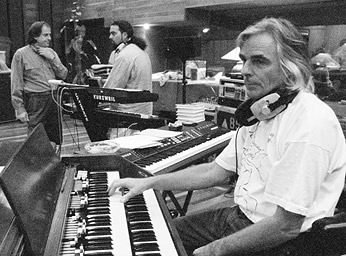
( Rick Wright recording with Pink Floyd at London’s Brittania Row studio in 1993 ).
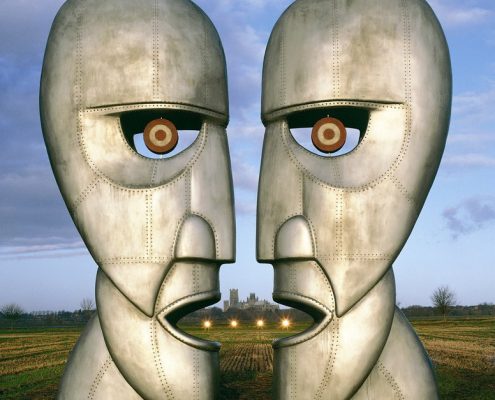
Never intended to be the last word in the long-running Pink Floyd legacy, nevertheless March 1994’s The Division Bell became, in effect, the final offering of new music from the remaining triumvirate of singer/guitarist/composer David Gilmour, drummer Nick Mason, and keyboard player Richard Wright. The Division Bell sold over three million copies just in the Nineties, and the Pink Floyd tour mounted in support of its release grossed a reported $100,000,000 in concert ticket sales. Wow.
When Pink Floyd’s The Division Bell was released in March 1994, the term “Brexit” had not been coined and Elizabeth II was Queen. Astrophysicist Stephen Hawking (who did a cameo on the song “Keep Talking”), Pink Floyd keyboard player Rick Wright, orchestrator/arranger Michael Kamen, and longtime Pink Floyd manager Steve O’Rourke were all very much alive. Then, too, Polly Samson was known only as a journalist, and the three now-grown children she would bear with Pink Floyd guitarist/singer/composer David Gilmour were only a vibrato in Dave’s Stratocaster when I hosted the Division Bell world premiere broadcast in March across North America on opening night from Miami Joe Robbie Stadium on the Pink Floyd tour. Listening to this classic rock interview, one of the last ever with the gentle and fragile original Pink Floyd keyboard player Richard Wright, you would have no indication of the circumstances under which we had this conversation. In mid-March 1994 I had been driven to a decommissioned Air Force base in the California desert at dusk, where we were met at the gate by Military Police with white gloves and live ammo in their M-16 rifles. The reason that the British band Pink Floyd was rehearsing their 1994 Division Bell North American tour at a U.S. military base was simply because nothing smaller than a C-5 military transport hangar could accommodate the massive stage, lights, and sound system. A month later I would find myself broadcasting my Dallas/ Ft.Worth afternoon radio show live from the gondola of the Pink Floyd blimp airship (below,) with Captain Hunter letting me take the controls high over North Texas (I must admit, though, that Q102 Promotions Manager Kacy Harrison flew the blimp much better than I did).
For the thirtieth anniversary of this progressive rock milestone, David Gilmour and Nick Mason join me here In the Studio, plus archival comments from the late Rick Wright, to detail the songs “Keep Talking”, “What Do You Want from Me”, Rick Wright’s last lead vocal “Wearing the Inside Out”,”Take It Back”, “Coming Back to Life”, and the epic “High Hopes” for the future of Pink Floyd, which were cut short with Rick Wright’s death in September 2008. –Redbeard
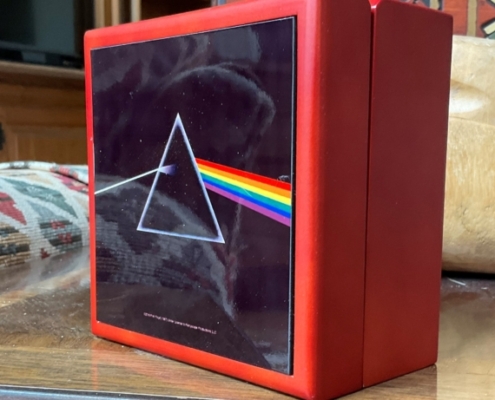
And so it was, the progressive rock masterpiece by Pink Floyd which not even “Time” can “Eclipse”: The Dark Side of the Moon! To illustrate how seriously many of the post-British Invasion bands were approaching the rock idiom by early 1973, you need look no further than Pink Floyd’s Dark Side of the Moon to see how this “progressive“ rock movement had matured, with spectacular results both artistically and commercially. Worldwide sales of Dark Side of the Moon are estimated at forty-five million copies! These facts are confirmed in this classic rock interview by my guests, musical lunar explorers David Gilmour, Roger Waters, and Nick Mason.
After a half-century of electronic music, it may be difficult for some to imagine that these sounds on Pink Floyd’s Dark Side of the Moon utilizing “The Putney” had never been head before in popular music, having escaped the laboratory only a few years prior. It has become rather painfully apparent that the musical tomb has been raided, the ultimate box sets already released, even some of the principals responsible for its creation, including Pink Floyd keyboard player Rick Wright and cover artist Storm Thorgerson, are now gone. What remains timeless, along with the music at the pinnacle of Progressive Rock, are the first-person stories of Dark Side of the Moon‘s conception, evolution, and recording by my guests Roger Waters, David Gilmour, and Nick Mason.
As you shall hear in my classic rock interview, none other than Paul McCartney and guitarist Henry McCulloch of Wings were both recorded for Dark Side of the Moon as two of the disembodied voices heard throughout Pink Floyd’s album. It’s McCulloch who is heard to say,”I don’t know, I was really drunk at the time”, but McCartney’s recording was dropped. Find out why here from Roger Waters. As early as the Moody Blues’ 1968Days of Future Passed, which was the result of a combination of new technology (the Mellotron , which crudely emulated choral and orchestral sounds) and desperation, an increasing number of British and European bands expanded rock’s canvas musically and lyrically without the slightest consideration to the pop hit mainstream. King Crimson’s stunning debut in 1969, In the Court of the Crimson King, inspired others such as fellow Londoners YES to releaseClose to the Edge less than a year after their breakthrough album Fragile . While not normally considered a prog-rock band, Traffic nevertheless had their biggest seller in 1972 with The Low Spark of High Heeled Boys, built around the 11 minute hypnotic title song which featured electronically synthesized saxophone, whileTrilogy from Emerson , Lake , and Palmer as well asFoxtrot and Selling England by the Poundfrom the Peter Gabriel-led Genesis, had critics raving and cash registers ringing.
(L-R: Nick Mason, David Gilmour, Roger Waters, Rick Wright)
Of course all of this would culminate in Spring 1973 with the incomparable Pink Floyd album The Dark Side of the Moon , an iconic masterpiece which long ago threw off any binders imparted by categorization merely as progressive rock, but not before both Jethro Tull’s Thick As a Brick and the Moody Blues’ Seventh Sojourn would each rack up #1 international sales in 1972. – Redbeard
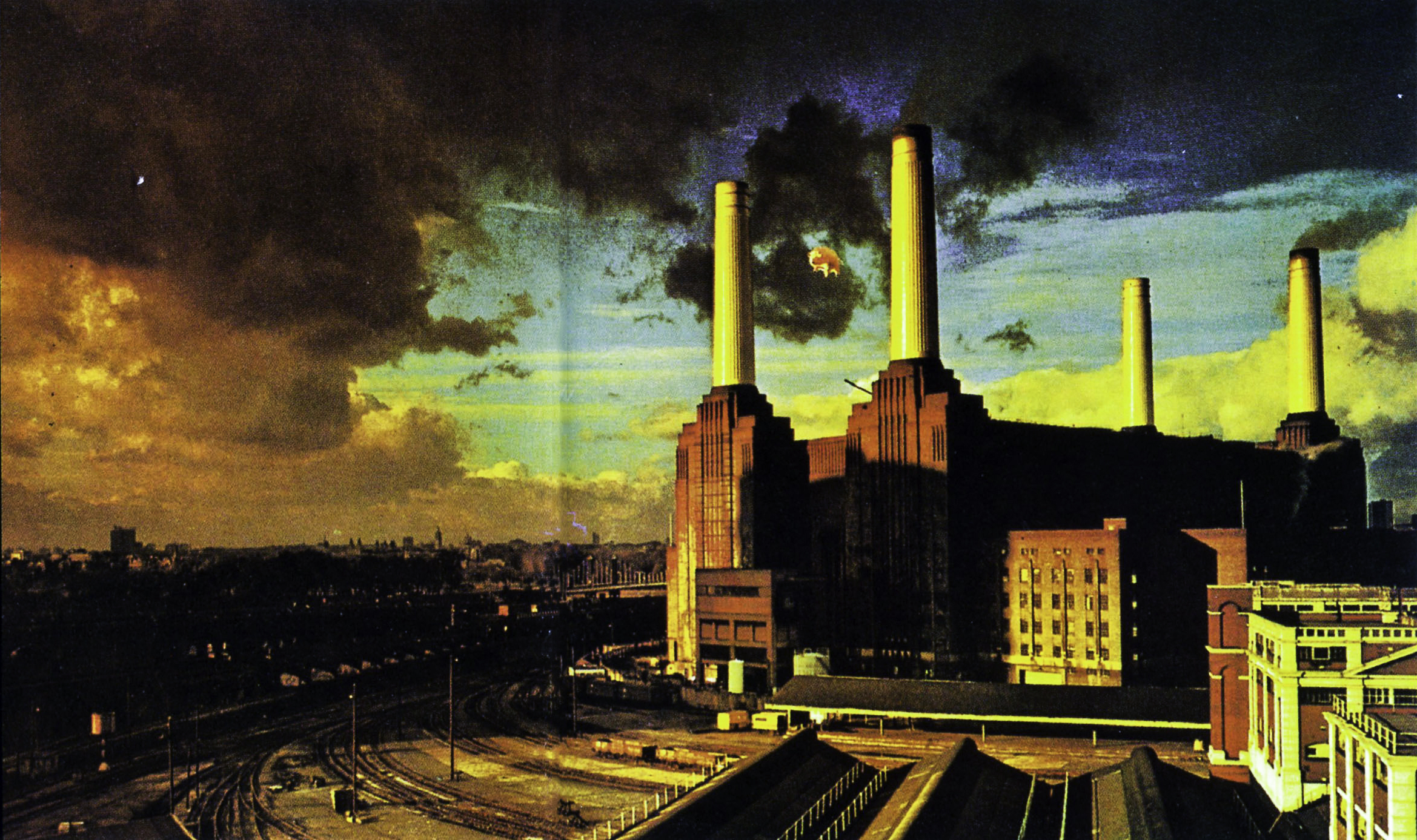
How did Pink Floyd devolve from the sublime introspection of Dark Side of the Moon in 1973 to the madness and despair of The Wall six years later? It’s a real zoo In the Studio with Pink Floyd Animals wranglers David Gilmour, Nick Mason, & former member and big-concept composer Roger Waters. Gilmour, Mason, and Waters explore the dark, ominous, yet vitally important transitional musical missing link, January 1977’s Animals, an album that was highly anticipated, here in my classic rock interviews. After all, the two Pink Floyd predecessors, Dark Side of the Moon and Wish You Were Here, were on their way to selling forty million copies, collectively, just in the U.S.
The original sound of the Animalsdisc was as dark and murky as Roger Waters’ vision of humanity, and I must confess that the combination of only three lengthy main songs,”Dogs”, “Pigs”, and “Sheep”, with that thick bass-heavy sonic presentation of the original, kept Animalsoff of much of American rock radio then. With the close-mic’ing technique of the musical instruments so popular then, the resultant sound of Animalscan be startling today with the latest 21st century remastering, like finding a pristine black pearl perfectly preserved in the muddy bottom of the stream of time.
With hindsight, it is clear that Pink Floyd’s Animals and its subsequent tour were the linchpin between the sublime Dark Side…, the melancholy Wish You Were Here, and the creeping numbing isolation of The Wall brought on by superstar success. Animals, though, was cynical, agitated, downright venal in places, Roger Waters’ vented emotions frozen in time then without the luxury of The Wall‘s explorations of Waters’ troubled childhood past for context, nor his future for resolution. Listening to Animals upon its release was the musical equivalent of suddenly coming upon a car crash and being aware immediately that serious trauma had occurred. The listener desperately wants to call for help, but who are we to notify? –Redbeard
It is no secret among Pink Floyd partisans that the incentive for the surprise emergence of The Endless River album was to honor the late Pink Floyd original keyboard player Richard “Rick” Wright. This is the full Rick Wright interview that we did in March 1994 while Pink Floyd were rehearsing in a B-52 hangar on a military base in the Southern California desert just days prior to the start of The Division Bell tour. The Pink prodigal son had contributed minimally at the end of recording for Pink Floyd’s 1987 comeback A Momentary Lapse of Reason but was sufficiently healthy enough to rejoin for the massive 1987-88 world tour. Comments by the late keyboard player who died in September 2008 also can be heard here In the Studio during Pink Floyd’s album The Division Bell. That’s Rick Wright on the organ at Britannia Row Studio. – Redbeard