Tag: rock music interview

  • Alice Cooper- Love It to Death/Killer 55th Anniversaries
    Alice Cooper- Love It to Death/Killer 55th Anniversaries

    Love It to Death in March 1971 may have been the third album by the band Alice Cooper, but that doesn’t change the fact that nobody bought the first two except Straight Records label owner Frank Zappa. Yet by December of that same year, EVERYBODY had heard “I’m Eighteen” off of Love It to Death,  and Alice Cooper had written and recorded a soon-to-be-classic additional full album, Killer. And indeed it was. Before year’s end, rock cognescenti would know that there were  new six-string gunslingers in town with  fully loaded clips of hollow-point hits, including “Is It My Body?” and “The Ballad of Dwight Fry” from Love It to Death and “Under My Wheels”,”Be My Lover”, the often misinterpreted anti-child abuse song “Dead Babies”, and the Jim Morrison tribute “Desperado”.

    Detroit’s blue-collar bars and cheap motels along Woodward Avenue may be less than two hundred miles away from the steps of the  Rock and Roll Hall of Fame in Cleveland, but it  turned out to be a four decade odyssey for Alice Cooper. Only in rock’n’roll can a preacher’s son named Vincent Furnier dress up in make-up, leather, and fishnet stockings while simulating his own execution by hanging, beheading, and electrocution as 10,000 mesmerized fans gladly pay for the macabre experience. Formed by five friends from Phoenix AZ, Vince’s band had quite a struggle choosing the right name for the group. Among the early choices were The Spiders, the Earwigs , & The Nazz (but Todd Rundgren had dibs on that last one). By 1969 they had moved to Los Angeles with the name Alice Cooper, but after recording two unsuccessful albums – Pretties for You and Easy Action– on Frank Zappa’s Straight Records label, Alice Cooper headed for Furnier’s birthplace of Detroit in hopes of better luck. Inking a deal with Warner Brothers, they actually released two albums in 1971,  Love It to Death and Killer , with both albums becoming successful. When I first saw Alice Cooper (that was the band‘s name then, as well) shortly after the March 1971 release of their third album Love It to Death, he was genuinely menacing. Trust me, the audience never rushed the low six-foot stage that night in an Ohio cornfield near Bowling Green, fearing that Alice’s dark intimidating prowling would escape the invisible boundary that separated our hippie peacenik world from his dark vision. There was no hint then of the clever humor that would  inform some of his later work. At a time when Mick Jagger and David Bowie were sporting eyeshadow and feather boas, Alice Cooper was  appearing in a straitjacket… draped in a REAL boa constrictor.

    Alice proves in my classic rock interview that  you can project practically any fringe, edgy, sociopathic image in rock and get away with it – as long as you deliver the hits. And beginning with “I’m Eighteen”, followed in rapid succession by “Under My Wheels”,”Be My Lover”,“School’s Out”,”Elected”,”No More Mr Nice Guy”,”Welcome to My Nightmare”, and “Only Women Bleed”, Alice Cooper and his long-suffering intrepid producer then and now on the recent Detroit Stories, Bob Ezrin, indelibly changed the rock world and revolutionized  American Top 40 radio. -Redbeard

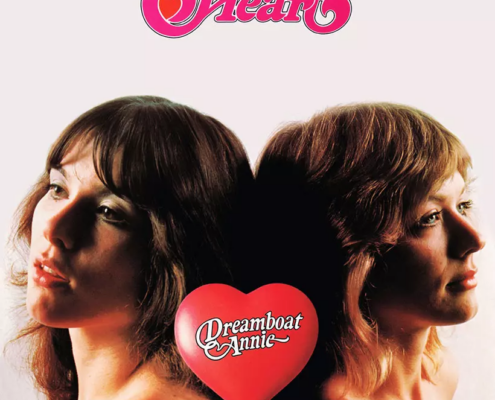
  • Heart- Dreamboat Annie 50th- Ann Wilson, Nancy Wilson
    Heart- Dreamboat Annie 50th- Ann Wilson, Nancy Wilson

    If there is a real-life Cinderella story in rock history, Heart’s debut Dreamboat Annie is it. Talk about “indie credibility”? These ladies wrote the book. When Heart’s 1976 debut Dreamboat Annie,  containing “Magic Man”,”Crazy on You”,”White Lightning and Wine”, and the languid title song was released on Valentine Day 1976 on tiny Canadian label Mushroom Records, it was simply because not one major U.S.  label was interested.

    After countless bar gigs throughout the Western Provinces, Heart sold 30,000 copies literally from the trunk of their car before getting US regional distribution across the border in Seattle. That is where the Wilson sisters, gifted singer/songwriter Ann and younger guitarist sibling Nancy, had settled with their military family, which moved often (dad was a Marine officer). It is apparent in this interview that the transient nature of that life, and the impermanence of friendships, resulted in the Wilson sisters looking to each other for a loyal, enduring bond that would last regardless of time, place, or circumstances.
    Mt. Rainier was not my first volcano (no, that would have been a few months earlier  on my honeymoon in Hawaii). But it was breathtaking and unforgettable on that late Saturday early September morning in Seattle. Or more accurately at that very moment, Snohomish, as I had missed the exit to Heart singer/songwriter Ann Wilson’s house and was halfway to Canada. Now I had turned the rental car around headed in the right direction and there it was: Mt. Ranier in all of its snow-capped glory, silhouetted against the bluest sky this side of Maui. It was a good omen for one of my favorite In the Studio  episodes ever. The scheduled noon classic rock interview with Ann Wilson was held in her quaint 19th century yellow and white-trimmed wooden  house on the secluded wooded hilltop, an historically preserved building which had hosted many colorful lives besides rockers and folkies as it had seen service as a brothel at one point. I even had the pleasure of meeting another non-performing Wilson sister, an indicator of just how closely knit the clan has always been, probably a direct result of Dad Wilson being a lifer in the Marines, which required mom and the girls to move multiple times when he was deployed.

    More than ten years passed between first meeting Ann and Nancy Wilson of Heart and my  opportunity to do an in-depth interview with them, the first of many subsequent conversations. That initial meeting was backstage after an early Summer 1978 performance in Springfield MA, and  their 1976 debut Dreamboat Annie had done the nearly impossible feat of breaking the band with their first effort in America, on a tiny Canadian indie label, no less. Heart was the opening band that night, but possibly a sign that this would not long be the case is the fact that I cannot recall who the headliner was, but it must not have mattered much at that time  since we hurried backstage to meet these newest stars and stood in a receiving line for a few minutes with Ann and Nancy. Heart had just released their first album for venerable CBS Records, Little Queen, and there stood the Wilson sisters in the same medieval laced-bodice dresses in which they appear on the album cover and had worn  on stage earlier that evening. Ann was wide-eyed and smiling while Nancy appeared thin, delicate, and demure, but their poise and charm was evident even then.

    Over a decade later, as I exited Ann Wilson’s charming yellow clapboard house with white trim atop a tree-covered hill in Seattle ( a historically significant late 19th Century structure which Ann claims was at one time a brothel), I had thoughts of the myriad of career successes and hurdles that the Wilson sisters had experienced by then. Ann’s quick wit and hearty laughter has certainly grown more keen and incisive over time, while Nancy has clearly become more confident and fully her big sister’s equal in leading Heart, but the gracious charm they both exuded on that first U.S. tour remains.

    For the first, and as it turned out, only time in our many conversations over three decades, guitarist/ singer/ songwriter Nancy Wilson was interviewed in Los Angeles separately from big sister Ann here, as she had just married rock journalist Cameron Crowe back then, whose star as a Hollywood screenwriter/ director was on the rise, and Nancy’s lovely appearance was a natural fit for some cameos as well. Even now on its golden anniversary, Ann and Nancy Wilson’s real life rock Cinderella story, times two, of Dreamboat Annie  has always remained one of my all time favorite interviews in the  history of In the Studio. –Redbeard

  • Moody Blues- Days of Future Passed

    Moody Blues- Days of Future Passed

    The Moody Blues’ Days of Future Passed in November 1967 stands even today as one of the pillars at the portal to Progressive Rock (the other being In the Court of the Crimson King about a year later), and for the first-person story of this essential album, we have Justin Hayward and  the late John Lodge as our guides here In the Studio. But you may be surprised to find that much of the legend of Days of Future Passed is actually myth.

    The many musical assumptions surviving the Moody Blues’ groundbreaking November 1967 second album, Days of Future Passed, were variously confirmed, corrected, and embellished by my guests Justin Hayward and John Lodge here In the Studio in this classic rock interview. Among them:

    -After singing “Go Now” in 1964, lead singer Denny Laine left the Moody Blues with the name, one hit, and 5,000 British pounds in debt to their record company. Young unknowns Justin Hayward and John Lodge were added. Hayward claims that he got the gig “…because I had an amplifier!”

    -The Moody Blues did not have a record album contract with label Decca, just a deal for a few single sides.

    -Reduced to playing supper clubs, the band had to sell their equipment van to survive.

    -Hayward, Lodge, drummer Graeme Edge, flautist Ray Thomas, and keyboard player Mike Pinder could not afford recording studio time, so in an effort to recoup their modest 5000 British pound investment, the label allowed the band to record at times when the studio was vacant, usually a few hours in the middle of the night. -The first recording of Justin Hayward’s “Nights in White Satin” by the Moody Blues was for a BBC radio program. After the one-time broadcast, the network reused the tape by recording over it, effectively destroying the only recording of “Nights…” at the time.

    -The Moody Blues did NOT record with the London Festival Orchestra on Days of Future Passed. “They only played in the gaps between our songs,” points out Justin Hayward.

    -Though technically not the first rock opera (there are no characters), the album’s song cycle of a 24-hour day is one of the first rock concept albums, and is widely cited as the dawn of Progressive Rock.

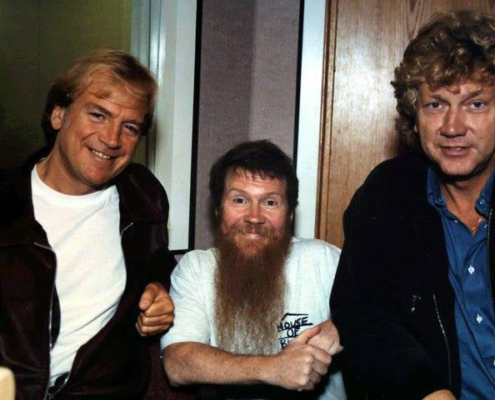
    -Some 70 million album sales and over half a century later, the Moody Blues have been able to replace their van, and have  been invited to park it permanently at the Rock and Roll Hall of Fame. You  helped correct that inexplicable omission by voting  the Moody Blues in for the Spring 2018 ceremony. ( Justin Hayward (l) and John Lodge (r).

    Moody Blues mainstays Justin Hayward and John Lodge document the fascinating story of a true Hail Mary pass to avoid abject poverty and starvation, resulting not only in timeless hits “Tuesday Afternoon” and “Nights in White Satin” but also igniting a musical movement, Progressive Rock, that combined the psychedelic sounds of 1967 with the orchestral grandeur and literary purpose of the classics. –Redbeard 

  • Santana- Abraxas- Carlos Santana, Gregg Rolie, Michael Shrieve
    Santana- Abraxas- Carlos Santana, Gregg Rolie, Michael Shrieve

    In more than 1600 documentary episodes spanning over thirty years, I can honestly say that we never featured a more influential, important, essential album than Santana ‘s second effort Abraxas, released in October 1970. Containing the infectious”Oye Como Va”, the heavy Gregg Rolie organ rocker “Hope You’re Feeling Better”, the gorgeous guitar instrumental “Samba Pa Ti”, and the classic cover of the late Peter Green/Fleetwood Mac blues “Black Magic Woman”, Abraxas conjures up mystical, steamy Afro-Cuban, jazz, Tejano, soul music electrified by the searing guitar of Mexican immigrant Carlos Santana. Simply stated, this is the Rosetta Stone of World Music. Carlos and Gregg are joined by drummer Michael Shrieve  of Santana here In the Studio.

    When a young Carlos Santana first was recognized as possessing a remarkable talent for playing the guitar, he was a Mexican immigrant working as a dishwasher in a San Francisco Bay Area Tick Tock restaurant. Humble beginnings, which he shares in my classic rock interview In The Studio for October 1970’s Abraxas. Only Santana’s second release, this iconic album is ranked at #203 on Rolling Stone‘s Top 500 Albums of All Time (the debut Santana  ranks even higher, at #149) . The leap in maturation and production sophistication on Abraxas, as compared to their first album, is striking. In 1970, nothing else sounded like it, and scarcely anything quite like it since has so successfully integrated rock, blues, jazz, and Latin music. In this classic rock interview, Carlos Santana tells me, “Ever since I crossed the border, my life has been like Disney Land.” But apparently the American Dream continued , as former U.S. President Barack Obama  awarded Carlos the prestigious Kennedy Center honors for Santana’s contributions in music and humanitarian efforts. –Redbeard

    SANTANA-article-2520529-19F78BED00000578-735_306x423

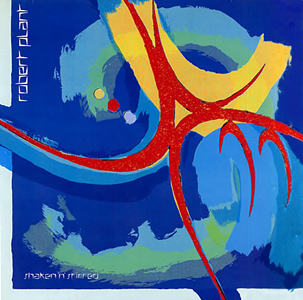
  • Robert Plant- Shaken ‘n’ Stirred

    Robert Plant- Shaken ‘n’ Stirred

    In 1985, Robert Plant had just raised eyebrows (and skirts) with his retro-rockin’ big band one-off The Honeydrippers, only to follow it up with the adventurous modern rock-influenced Shaken ‘N’ Stirred. His third solo album bearing his name, Shaken ‘N’ Stirred  contained the infectious song “Little by Little” which helped to drive the album sales to #19 in Robert Plant’s UK homeland, as well as #20 Billboard charting in the US.

    It was 1983’s The Principle of Moments, Robert Plant‘s second solo album, which  convinced us that Plant could sustain a viable solo career outside of the legendary Led Zeppelin which he fronted for twelve fabled years. But for me personally it was Shaken ‘n’ Stirred,  served up pre-release on a little Walkman cassette player onboard a Boeing 747  at 40,000 feet over the Atlantic Ocean, that began my professional relationship with the complicated singer.

    Angular extended songs “In the Mood” and the cryptic “Big Log” from The Principle of Moments  became rock radio staples in the States, followed by the earworm “Little by Little” from Shaken ‘n’ Stirred  in 1985. However, not until 1988’s Now and Zen ( his fourth solo sortie if you don’t count the one-off Honeydrippers  EP) did Plant shed the self-conscious shadow of Led Zeppelin by exorcising his ghosts with the song ” Tall Cool One”, brilliantly sampling the “thunder of the gods” iconic licks and employing Zeppelin mastermind Jimmy Page on guitar.“Heaven Knows” and “Ship of Fools” made Now and Zen a blockbuster, with “Hurting Kind” in 1990 from Manic Nirvana  and the tender heartfelt “29 Palms” on Fate of Nations completing our visit with Robert Plant In the Studio for this classic rock interview.- Redbeard

  • Night Ranger- 7 Wishes @40- Jack Blades

    Night Ranger- 7 Wishes @40- Jack Blades

    “We made our first video for the song ‘Don’t Tell Me You Love Me’ for ten thousand dollars,” Night Ranger singer/songwriter/bass player Jack Blades confesses in this classic rock interview, which starts at the beginning for the California band’s Dawn Patrol  debut album in 1982 (Billboard #38 sales). Now to you and me, ten grand sounds like a lot of money, but in the MTV Eighties, entire albums were being recorded for less than $50K, while a single song video price tag easily could top twice that much.

    In 1982-83 Night Ranger was practically the first American band to break out simultaneously on rock radio as well as MTV. The new 24 hour music video channel in America meshed seamlessly with Blades, singing drummer Kelly Keagy, and lead guitar player Brad Gillis (all from the band Rubicon) alongside Montrose veteran keyboard player Alan Fitzgerald and guitarist Jeff Watson in the studio, on stage, and on screen. Songs “Sing Me Away” from Dawn Patrol; the anthem “You Can Still Rock in America”, “When You Close Your Eyes”, all from Midnight Madness (#15 Billboard Album Sales chart); and “Four in the Morning” plus the touching true story “Goodbye” are all chronicled here by Jack Blades, those last two from Seven Wishes  in May 1985.

    (Flanked backstage in Dallas Summer 2014 by two of the sweetest guys in rock, Night Ranger’s Kelly Keagy (l) and Jack Blades (r).)

    But it was the song “Sister Christian” (Billboard #5 on their Hot 100), written by Keagy about his sister Christie, which Night Ranger demo’d but decided to leave off of their Dawn Patrol  debut. “Sister Christian” could not be denied in 1984 on the follow up Midnight Madness, becoming the high school prom/graduation song that year for millions.  – Redbeard

  • Doobie Brothers- What Were Once Vices…/Stampede- Tom Johnston, Pat Simmons

    Doobie Brothers- What Were Once Vices…/Stampede- Tom Johnston, Pat Simmons

    Even a half-century after its April 1975 release, the two things I recall most about Stampede, the fifth album from San Jose’s Doobie Brothers, was the duality evident in the band’s emerging sound. There was the noticeable sophistication in the sweeping symphonic arrangements by concert master Nick DeCaro, embellishing Pat Simmons’ ostensibly acoustic ballad “I Cheat he Hangman”, but in stark contrast to the Doobie Brothers’ big hit with the Motown cover of “Take Me in Your Arms (Rock Me for a Little While)”. Meanwhile, the Doobie Brothers’ brutal non-stop touring schedule then was about to move multiple original members from Injured Reserve to the Disabled List, including singer/songwriter/frontman guitarist Tom Johnston.

    By the time the Doobie Brothers’ fourth album, What Were Once Vices are Now Habits, was released in early 1974, their third, The Captain and Me  a year earlier had proven that 1972’s Toulouse Street  and the hit “Listen to the Music” were no flukes. The Doobie Brothers went from playing bars around their native San Jose and San Francisco Bay Area to theaters and small halls across America. “Another Park, Another Sunday” was chosen by the band’s record company as the first single from Vices…/Habits, but it stalled at only #32. Despite the seemingly unstoppable groove of the next single choice, “Eyes of Silver”, featuring the infectious soul of the Memphis horns, that single failed to even make  it past #52. Then a remarkable thing happened:  an album track from …Vices/…Habits  received considerable airplay on the  progressive rock FM radio stations which were growing in popularity. Never intended by the Doobie Brothers’ record company to be a single ( it had been the “B” side to “Another Park, Another Sunday” eight months earlier, in fact), “Black Water” revived the dismal sales picture, becoming the band’s first #1 song and eventually selling over one million copies of What Were Once Vices…Habits.

    In April 1975 the Doobie Brothers released their fifth album, Stampede, a Top 5 seller containing Pat Simmons’ epic “I Cheat the Hangman” and the dance floor favorite Motown cover, “Take Me in Your Arms (Rock Me a Little While)”, which just grazed the Top 10. Simmons and Doobie Brothers prodigal son Tom Johnston join me In the Studio in this classic rock interview. Patrick Simmons, singer/songwriter/ guitarist and the only musician to appear on every Doobie Brothers album and tour in their fifty-five year career, told me in this classic rock interview, “For us at that time, we were just plain lucky.” The surprise success from “Black Water” afforded the band some creative license on their next album, Stampede,  released in April 1975. There is the Jack Kerouac On the Road -themed “Neal’s Fandango”; the sweeping energetic take on the Holland-Dozier-Holland songwriting juggernaut’s Motown hit for Kim Weston, “Take Me in Your Arms (Rock Me for a Little While )”, which made it to #11 for the Doobie Brothers; and several big name guest musicians helping to make Stampede the best sounding Doobies album to date. But as you will hear from Simmons, Johnston, and the late Doobie drummer Mike Hossack, the non-stop grind of five years of one-nighters, stopping only long enough to record the next album, was starting to create stress fractures in the foundation of the band which  would sideline Tom Johnston with a bleeding ulcer and, ultimately, alter the sound of the Doobie Brothers for the next decade. –Redbeard

  • Pete Townshend- Who Came First

    Pete Townshend- Who Came First

    Just watching the parade of some of the latest overly-ambitious, under-qualified politicians on the Sunday morning tv talkshows ever since 1972’s Who Came First by Pete Townshend, quickly it becomes clear that one need not actually lie to obfuscate the truth. Handlers teach them that you need not answer any direct question posed by an interviewer; rather, you simply rephrase the question with one that you do feel comfortable answering. Repeat a half-truth enough times in public and a certain percentage of the population will soon accept it, unchallenged, as fact. Pete Townshend has no such handlers, and I’m convinced that he would ignore any attempts at spin control even if he did.

    Townshend is the “George Washington of rock”, in that he seems incapable of telling a lie, even when the unvarnished truth paints him in a less than favorable light. Pete continues his frank critical assessment of The Who here, but saves his most revealing confessions for his solo works in my classic rock interview, including Who Came First,  All the Best Cowboys Have Chinese Eyes , White City, and his April 1980 critical and commercial success Empty Glass, all wonderfully represented on the collection Truancy: the Very Best of Pete Townshend.
    The release of Pete Townshend’s solo album Empty Glass in April 1980 was quite the media event, for a number of reasons. First, his new New York City-based label then was thrilled to get The Who’s genius songwriter after coveting the iconic group for many years, so much so that they erroneously promoted Empty Glass as Townshend’s first solo effort, at Townshend’s self-conscious insistence ( 1972’s Who Came First  had that distinction).
    By April 1980 we in the rock music world were beginning to miss Townshend’s new music, which had been a pretty consistent mainstay of rock’n’roll for fifteen years prior but had been understandably MIA since the sudden death of madcap Who drummer Keith Moon in 1978. Townshend filled Empty Glass   with his grief over the loss of his friend, as well as very personal subjects including alcoholism, marital problems, and his conflicted reaction to Punk Rock in the songs”Rough Boys”,”A Little is Enough”,”Gonna Get Ya”, and pop spiritual”Let My Love Open the Door”, a Top Five US hit. –Redbeard

  • Aerosmith- Toys in the Attic- Steven Tyler, Brad Whitford, Joey Kramer, Tom Hamilton, Joe Perry
    Aerosmith- Toys in the Attic- Steven Tyler, Brad Whitford, Joey Kramer, Tom Hamilton, Joe Perry

    We dust off Toys in the Attic,  the breakthrough third album for Aerosmith in  April 1975. Toys in the Attic  was the foothold  for Aerosmith to climbing the sales charts on their way to becoming America’s most popular and influential hard rock band. Containing perennial favorites “Walk This Way”,”Sweet Emotion”, the first anti-child abuse song “Uncle Salty”, the circular contagion of “No More, No More”, a swingin’ cover of Bullmoose Jackson’s bawdy “Big Ten Inch”, and the riff rock title song, Toys in the Attic  showed that my guests Steven Tyler, Brad Whitford, and Joey Kramer, along with bassist Tom Hamilton and lead guitarist Joe Perry, were not toying around.

    Contrary to what you might assume, through their first two albums Aerosmith struggled to get noticed. In this classic rock interview, Aerosmith drummer Joey Kramer reminded me that “Dream On” from their debut by then had been released as a single three times,  and flopped twice. Sure, a few of us intrepid radio deejays played it  plus by several songs  on Get Your Wings (my efforts were confirmed years later in the band’s autobiography Walk This Way  when Aerosmith noted that, outside of the Boston base, their next biggest crowds & sales circa 1973-74 were in Marion, Ohio), but Toys in the Attic changed all that in Spring 1975, eventually racking up over eight million copies sold and a ranking of #229 on Rolling Stone magazine’s Top 500 Albums of All Time list. –Redbeard
    (
    Rock stars do homework, too: L-R Alice Cooper, Mick Fleetwood, Aerosmith’s Steven Tyler, and Sammy Hagar inspect Peter Green’s original hand-written lyrics for Fleetwood Mac’s “Rattlesnake Shake”)

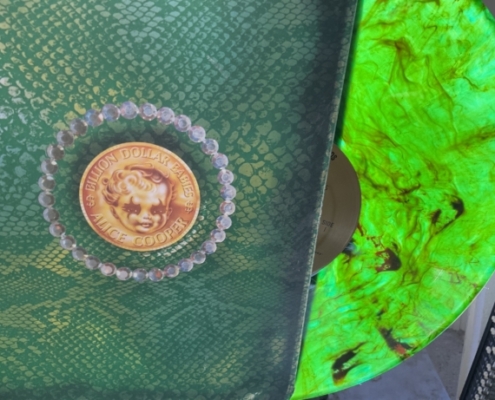
  • Alice Cooper- Billion Dollar Babies

    Alice Cooper- Billion Dollar Babies

    In February 1973 when Alice Cooper‘s sixth album Billion Dollar Babies was released, eventually going to the  #1 sales perch in both the US and UK, Alice was so far ahead of pop culture that Cooper didn’t need pronouns. At the time we all thought that Marshall McLuhan, Andy Warhol, and Alice Cooper were being hyperbolic with their  predictions about video fame’s future impact on society. We laughed then, but as it turns out, the joke’s on us.

    Detroit’s blue-collar bars and cheap motels along Woodward Avenue may be less than 200 miles away from the steps of the modernistic I.M.Pei-designed Rock and Roll Hall of Fame in Cleveland, but journey turned out to be a forty year odyssey for Alice Cooper. Only in rock’n’roll can a preacher’s son named Vincent Furnier dress up in make-up, leather, and fishnet stockings while simulating his own execution by hanging, beheading, and electric chair as 10,000 mesmerized fans gladly pay for the macabre experience.When I first saw Alice Cooper (that was the band’s name then, as well) shortly after the March 1971 release of their third album, Love It to Death,  he was genuinely menacing. Trust me, the audience never rushed the low six-foot stage that night, fearing that Alice’s dark intimidating prowling would escape the invisible fourth wall boundary that separated our hippie peacenik world from his real-time nightmare. There was no hint of the clever humor that night that would  inform Billion Dollar Babies  merely two years later. At a time when Mick Jagger and David Bowie were sporting eyeshadow and feather boas, Alice Cooper was  appearing in a straitjacket draped in a REAL boa constrictor. Alice proved that  you can project practically any fringe, edgy, sociopathic image in rock and get away with it – as long as you deliver the hits. And beginning with “I’m Eighteen”, followed in rapid succession by “Under My Wheels”,”Be My Lover”,”School’s Out”,”Elected”,”No More Mr Nice Guy”,”Welcome to My Nightmare”, and “Only Women Bleed”, Alice Cooper indelibly changed the rock world and revolutionized the American top forty radio. Think about it: Jimi Hendrix, Jim Morrison, Janis Joplin, Keith Moon, Elvis PresleyTo 99% of us, the first indication that these titans of rock had a dangerous addiction was when we read the headlines that they were dead. Alice Cooper was the first rock star to fall to substance abuse…and survive. Following his long-overdue induction into the Rock’n’Roll Hall of Fame, Alice Cooper returns with me In The Studio to discuss, in frank detail in my classic rock interview, his descent into the personal hell of alcoholism which threatened not only his career and marriage but even his very life.– Redbeard