Tag: Days of Future Passed

  • Moody Blues- Days of Future Passed

    Moody Blues- Days of Future Passed

    The Moody Blues’ Days of Future Passed in November 1967 stands even today as one of the pillars at the portal to Progressive Rock (the other being In the Court of the Crimson King about a year later), and for the first-person story of this essential album, we have Justin Hayward and  the late John Lodge as our guides here In the Studio. But you may be surprised to find that much of the legend of Days of Future Passed is actually myth.

    The many musical assumptions surviving the Moody Blues’ groundbreaking November 1967 second album, Days of Future Passed, were variously confirmed, corrected, and embellished by my guests Justin Hayward and John Lodge here In the Studio in this classic rock interview. Among them:

    -After singing “Go Now” in 1964, lead singer Denny Laine left the Moody Blues with the name, one hit, and 5,000 British pounds in debt to their record company. Young unknowns Justin Hayward and John Lodge were added. Hayward claims that he got the gig “…because I had an amplifier!”

    -The Moody Blues did not have a record album contract with label Decca, just a deal for a few single sides.

    -Reduced to playing supper clubs, the band had to sell their equipment van to survive.

    -Hayward, Lodge, drummer Graeme Edge, flautist Ray Thomas, and keyboard player Mike Pinder could not afford recording studio time, so in an effort to recoup their modest 5000 British pound investment, the label allowed the band to record at times when the studio was vacant, usually a few hours in the middle of the night. -The first recording of Justin Hayward’s “Nights in White Satin” by the Moody Blues was for a BBC radio program. After the one-time broadcast, the network reused the tape by recording over it, effectively destroying the only recording of “Nights…” at the time.

    -The Moody Blues did NOT record with the London Festival Orchestra on Days of Future Passed. “They only played in the gaps between our songs,” points out Justin Hayward.

    -Though technically not the first rock opera (there are no characters), the album’s song cycle of a 24-hour day is one of the first rock concept albums, and is widely cited as the dawn of Progressive Rock.

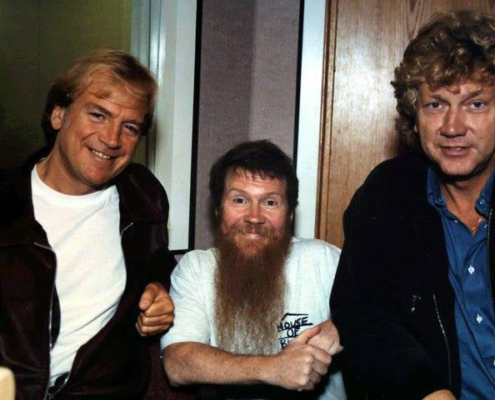
    -Some 70 million album sales and over half a century later, the Moody Blues have been able to replace their van, and have  been invited to park it permanently at the Rock and Roll Hall of Fame. You  helped correct that inexplicable omission by voting  the Moody Blues in for the Spring 2018 ceremony. ( Justin Hayward (l) and John Lodge (r).

    Moody Blues mainstays Justin Hayward and John Lodge document the fascinating story of a true Hail Mary pass to avoid abject poverty and starvation, resulting not only in timeless hits “Tuesday Afternoon” and “Nights in White Satin” but also igniting a musical movement, Progressive Rock, that combined the psychedelic sounds of 1967 with the orchestral grandeur and literary purpose of the classics. –Redbeard 

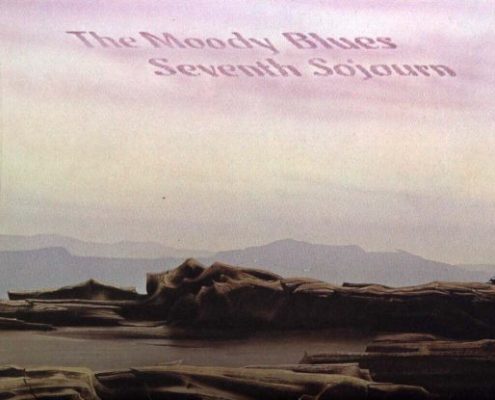
  • Moody Blues- Seventh Sojourn- Justin Hayward, John Lodge
    Moody Blues- Seventh Sojourn- Justin Hayward, John Lodge

    Time, the true arbiter of art, has been most kind to the Moody Blues’ Seventh Sojourn over more than five decades since its November 1972 release, which cannot necessarily be said for all of the band’s releases up until then. When the subject of rock star excess and decadence is broached, the last band that could possibly come to mind would be Birmingham England’s Moody Blues. After all, singer/lead guitarist Justin Hayward, the late bass guitarist/singer John Lodge, keyboardist Mike Pinder, the late flautist/singer Ray Thomas, and dearly missed drummer Graeme Edge spent their first seven albums searching for Truth with a capital “T” through music, love, and Transcendental Meditation. Yet by the time  their late 1972 album Seventh Sojourn became a worldwide #1 seller, the enormous success that had supplanted the Moody Blues’ abject poverty immediately prior to releasing 1967’s Days of Future Passed only five years earlier, had transformed their lives. But according to Justin Hayward, it wasn’t always for the better.

    “I joined the band when I was nineteen,” confesses Hayward. “I did all of my growing up in the band. (By 24) I didn’t have any life (outside the Moody Blues). I didn’t exist as a person.”

    John Lodge of the Moody Blues remembers vividly a powerful moment on what became the longest, highest-grossing concert tour to date in rock history in 1973-74. “We’d chartered our own Boeing 707 and hired a keyboard player to play (on the huge four-engine jet) in a disco floor…for just the five of us! We had our own butler. And I remember walking from the front of the 707 to the back restroom…past the organist playing, a bartender making drinks, past a sitting room with a fireplace, past two bedrooms. And when I was in the toilet I thought, ‘I’ve never been so lonely in my life! This is ridiculous. I don’t really want to be on this plane’.” Along with Jethro Tull’s #1 seller Thick As a Brick   and Close to the Edge  by YES,  the third jewel in 1972’s triple crown of progressive rock, Seventh Sojourn,  comes from the Moody Blues. Rock historians are quick to point out that, with the Beatles two years gone, the Rolling Stones , The Who, and Led Zeppelin were vying for the unofficial title of World’s Greatest Rock Band then. Yet it’s the Moody Blues who were equaled only by  the Beatles in placing two albums in the Top Five sales chart simultaneously when Seventh Sojourn  went to #1 in the U.S. in 1973, along with a grassroots radio revival of Days of Future Passed.

    Moreover, the Moody Blues’ appeal was so worldwide that they embarked on the longest extended tour in history up to that time and in so doing revolutionized the concert tour industry. However, the price of superstardom from such songs as “Isn’t Life Strange”,”Lost in a Lost World”,”For My Lady”,”New Horizons”, and “I’m Just a Singer in a Rock & Roll Band” turned out to be exceedingly high in karmic cost, as you will hear from the Blue Jays, Justin Hayward and John Lodge. –Redbeard</em

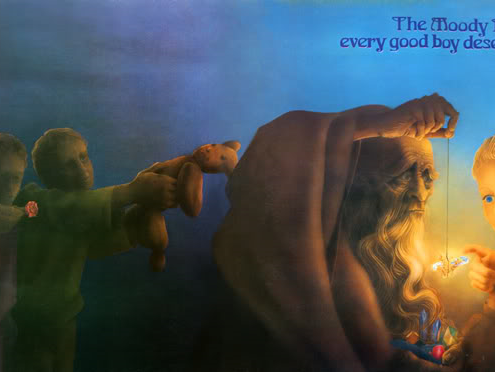
  • Moody Blues- Every Good Boy Deserves Favour 55th- Justin Hayward, John Lodge, the late Graeme Edge

    Moody Blues- Every Good Boy Deserves Favour 55th- Justin Hayward, John Lodge, the late Graeme Edge

    Writing on AllMusic.com, unabashed Moody Blues partisan Bruce Eder says of their July 1971 release Every Good Boy Deserves Favour (quote), “The best-realized of their classic albums…for the last time with this lineup.” That is high praise indeed, seeing as Every Good Boy Deserves Favour was the Moodies’ seventh album in a string of commercially and critically popular efforts, including Days of Future Passed, On the Threshold of a Dream, and A Question of Balance. 

    Singer/lead guitarist Justin Hayward, singer/bass player the late John Lodge, and drummer/band co-founder  Graeme Edge ( who passed away in November 2021 at the age of 80) take the occasion of Every Good Boy Deserves Favour to share, here In the Studio in  classic rock interviews, insights into some of the Moody Blues’ best of those early years, including “The Story in Your Eyes”, “Our Guessing Game”, and “Emily’s Song” from this UK #1 seller,  #2 US. –Redbeard