Tag: In the Studio

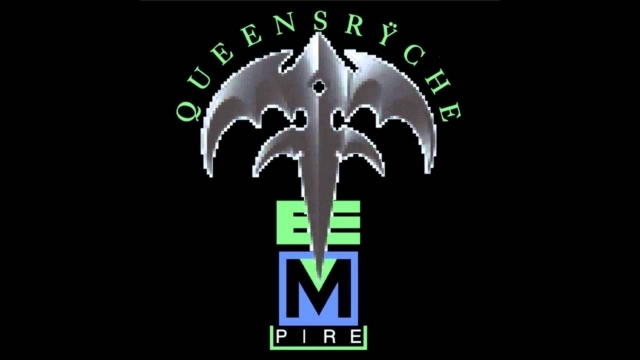
  • Queensryche- Empire @35- Geoff Tate, Chris DeGarmo

    Queensryche- Empire @35- Geoff Tate, Chris DeGarmo

    As early as 1983’s “Queen of the Reich”, Seattle’s Queensryche had shown that they could rock with conviction. While 1988’s thematic Operation: Mindcrime revealed keen collective intellect with bold musical ambition on songs such as “Eyes of a Stranger”, it was September 1990’s fourth full Queensryche effort, Empire, that planted the quintet’s flag in a whole new territory of popularity atop the sales charts. This Empire had scope, extending into the following year as the #9 seller for the entire year 1991! And Empire by Queensryche has aged not a lick in thirty-five years in its ability to rock your viral blues away while surgically implanting multiple massive chorus hooks in your head. Before leaving, Queensryche dual founders Geoff Tate and Chris DeGarmo held court with me while dealing in the coin of the realm including “Best I Can”,”Another Rainy Night”,”Jet City Woman”,”Resistance”, “Hand on Heart”, and the epic “Silent Lucidity” here In the Studio.

    Watching the February 1992 internationally-televised Grammy Awards, there was Queensryche performing the most unlikely Top Ten Billboard  hit and Grammy-nominated Rock Song of the Year, “Silent Lucidity” from September 1990 release Empire. Performed live with a symphony orchestra conducted by the late Michael Kamen and telecast worldwide to hundreds of millions, I couldn’t help but note how far Queensryche had come – how far rock had come – to be recognized in such a prestigious mainstream manner. As you hear in my classic rock interview, it certainly hadn’t started out that way for the Seattle quintet. Co-founder/composer/guitarist Chris DeGarmo and former singer/ songwriter Geoff Tate may be gone from Queensryche now ( the former pilots corporate jets, the latter heads the band Operation Mindcrime), but they tell the story of the blockbuster four million-seller Empire and the amazing songs “Best I Can”, “Jet City Woman”,”Della Brown”,” Resistance”,”Hand on Heart”, even a live performance from London’s Hammersmith Odeon just weeks after Empire’s 1990 release. –Redbeard
  • Rush- Counterparts- Alex Lifeson

    Rush- Counterparts- Alex Lifeson

    “You know, I think that a lot of Rush fans always wanted to hear us play like we used to play, if I can use that phrase,” Rush guitarist/co-writer Alex Lifeson admitted to me a couple of years after the October 1993 Counterparts album release. “Bringing back that certain quality that we had in our earlier days of the three-piece core of the band. And being more forceful with it, and more focused and direct. I think it (Counterparts) was something Rush fans really welcomed.”

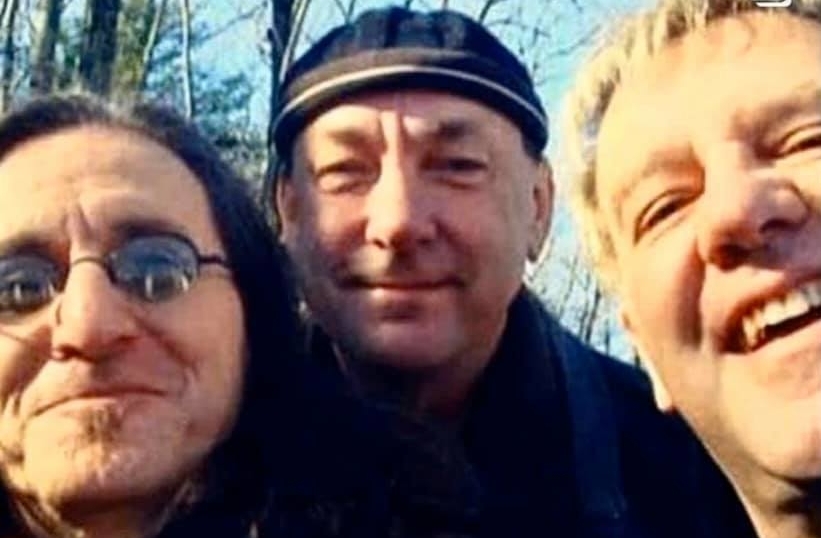
    On Counterparts the sheer amount of Alex Lifeson’s powerful electric guitar was immediately noticeable, for sure, but the “live off the floor” approach Rush returned to on Counterparts is really apparent now in the way that legendary drummer the late Neil Peart really swings in his playing. Peart adapted jazzy, dare I say even dancey, time signatures to his prodigious arsenal on songs including “Animate”,”Stick It Out”,”Cut to the Chase”, and “Cold Fire”, providing a pocket for Lifeson and Rush bass player/singer Geddy Lee to really show their chops. ( Geddy Lee (l), Neil Peart, and Alex Lifeson (r) in one of their last selfies)

    Counterparts also contains “Nobody’s Hero”, a stunning high point not only  for Rush but also for the whole of the Nineties imho. The late maestro Michael Kamen was brought in to impart the sweeping Imax grandeur that Neil Peart’s compassionate lyrics, and Geddy’s singing of same, required on “Nobody’s Hero”, a song that never fails to put a lump in my throat ever since. The result was a #2 Billboard magazine album sales debut, Rush’s highest American sales since Moving Pictures over a decade earlier. Alex Lifeson is my guest here In the Studio for Counterparts. –Redbeard

  • The Police- Ghost in the Machine 45th- Stewart Copeland, Andy Summers

    The Police- Ghost in the Machine 45th- Stewart Copeland, Andy Summers

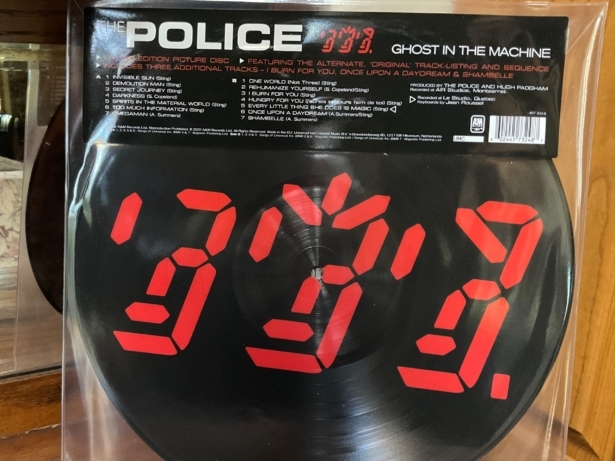
    By the time October 1981 ‘s fourth Police album Ghost in the Machine was dispatched, the exposed roots and influences shown by the London-based trio, founded by Yankee drummer Stewart Copeland, revealed the infectious pop of “Every Little Thing She Does is Magic” and “Spirits in the Material World”, as well as the brooding “Secret Journey”. Turned out that The Police, who had emerged from the dying embers of the London Punk Rock scene , were more Miles, Mingus, and Marley than Johnny Rotten.

    The preceding album by The Police only a year earlier, Zenyatta Mondatta, had been the keystone for these cops of rock, finally unlocking a jailbreak of three Top Twenty hits and selling over a million copies for the first time. With Ghost in the Machine they moved The Police headquarters to the Caribbean island of Montserrat to record a more varied group of song arrangements. The Police line-up included more synthesized keyboards and saxophones on “Spirits in the Material World”,”Hungry for You”,”Omega Man”, the mystical moody “Secret Journey”,”Invisible Sun”, and the huge worldwide hit “Everything She Does is Magic”. The grand jury court of public opinion was virtually unanimous in the affirmative, resulting in Ghost in the Machine topping the UK sales chart, #2 on Billboard  album chart, over three million copies sold in America alone, and Rolling Stone  magazine ranking it at #322 on their Top 500 Albums of All Time list. Police commissioner Stewart Copeland and six-string sharpshooter Andy Summers are your personal Ghost…busters in this classic rock interview. –Redbeard

  • Al Stewart- Year of the Cat 50th Anniversary

    Al Stewart- Year of the Cat 50th Anniversary

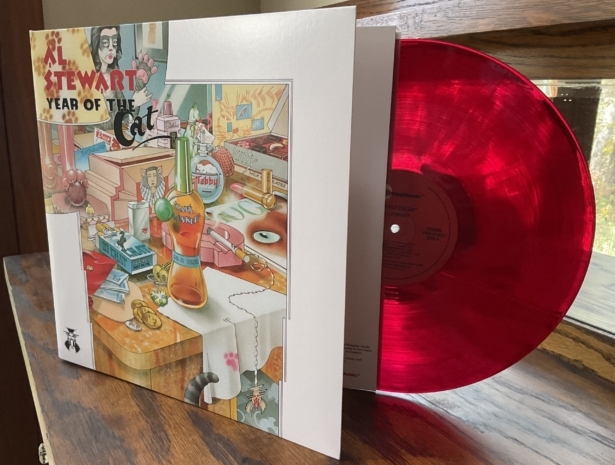
    On the eve of the July 1976 release of his seventh (!) album Year of the Cat,  Al Stewart’s career arc could have borrowed the title from the Academy Award-winning documentary Twenty Feet from Stardom.  From the beginning of my rare classic rock interview, Al Stewart might seem to be name-dropping big time. Except it’s all true: sneaking backstage during a 1963 Beatles concert and talking with John Lennon; rooming in London next to Paul Simon; befriended in the London coffee house scene by an unknown Cat Stevens; emcee-ing at a London nightclub when another unknown then, an American named Jimi Hendrix, decided to play his guitar with his teeth. Yet, being witness repeatedly to rock history apparently accounted for nothing when Al Stewart’s seventh album, Year of the Cat, was unceremoniously turned down  by every major UK record label.

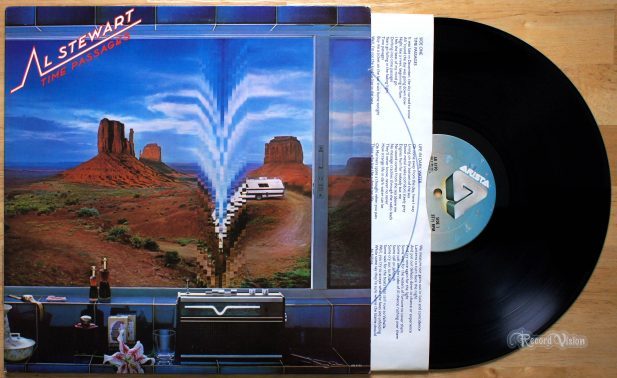
    It was a sunny cloudless autumn morning in 1988 outside a modest house perched high on the Southern California hillside above Malibu Beach and the Pacific Ocean. The owner of the house answered my knock still dressed in his bathrobe, vertically striped like Joseph’s biblical coat of many colors. Clearly I had surprised my interview subject with an earlier than anticipated arrival, but Al Stewart grinned and graciously let me invade his Saturday morning tranquility. At that time it was only the tenth anniversary of the second of his back-to-back multimillion-selling albums, Time Passages,  which like its predecessor, 1976’s Year of the Cat,  was produced by Alan Parsons just as Parsons launched his own career as a recording artist.

    But these mainstream hits by Al Stewart were far from his first attempts, coming instead after making no less than six albums, the first  four of which were practically ignored. Not until 1973’s Past, Present, and Future  and the epic “Roads to Moscow”, with its eight minute historically-based first person World War II narrative through the eyes of a young Russian soldier who had repelled the Nazi German tank invasion, did Al Stewart gain U.S. airplay. “I actually failed history class, at the most basic level. I did,” confesses Al ironically.

    The song “Carol” from 1975’s Modern Times  mid-charted as well, but with the title song to Year of the Cat  and “On the Border” in 1976, followed by “Time Passages” and “Song on the Radio two years later, Al Stewart became an unlikely mainstream hitmaker about as far removed from his humble mid-‘60s London Soho coffeehouse roots as one could ever imagine. – Redbeard 

  • Paul McCartney- Back in the US pt 2

    Paul McCartney- Back in the US pt 2

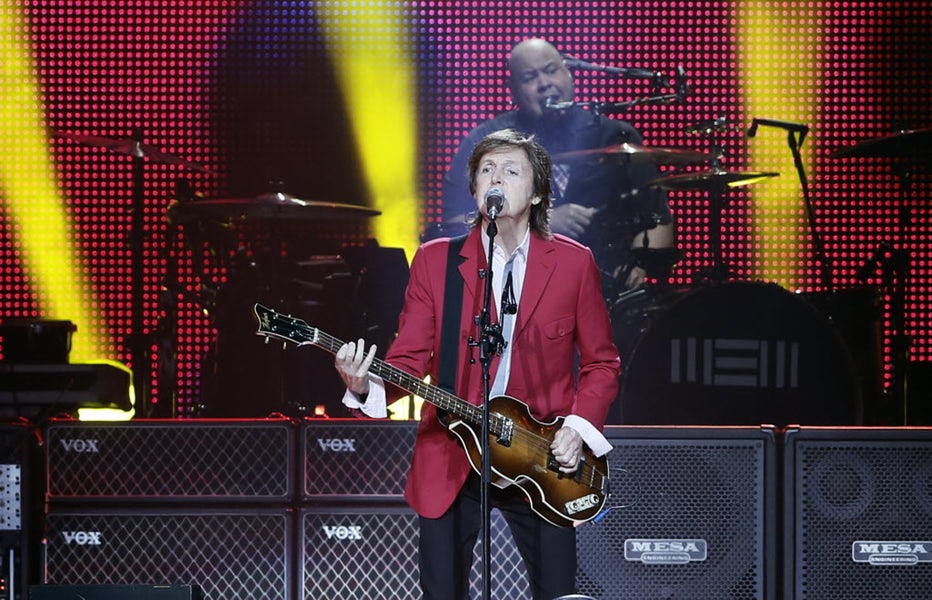
    Rock’s cross between Dorian Gray and the Energizer Bunny, Paul McCartney, was Back in the US pt2  once again in Summer 2019 vowing to “Freshen Up”  North American concert audiences all the way to Dodger Stadium. So what better time to sit down with McCartney to let him set the table for clearly what he loves to do? The conclusion in this classic rock interview. Let’s hope that it wasn’t the conclusion to Paul McCartney’s fabled touring life, the Last Macca Hurrah. –Redbeard


  • Hard+Heavy Box- Deep Purple, Whitesnake, KISS, Bad Company, Heart, Judas Priest, Boston

    Hard+Heavy Box- Deep Purple, Whitesnake, KISS, Bad Company, Heart, Judas Priest, Boston

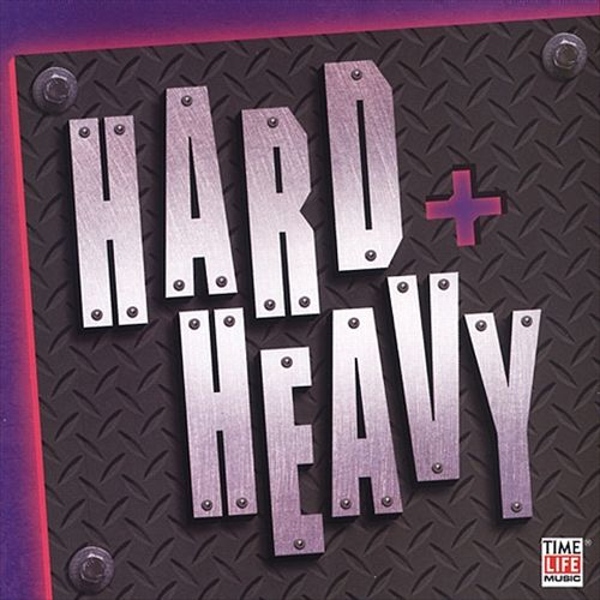
    When entities outside of the rock world try to define it, I usually hold my breath and cover my eyes, but in 2008 the folks at Time- Life   did a pretty impressive job collecting hard rock genre-defining classics from Deep Purple, Whitesnake, KISS, Bad Company, Heart, Judas Priest, Boston, Ted Nugent, and many more in a nine CD box set Hard + Heavy.  I asked Roger Glover and Ian Gillan, David Coverdale, Paul Stanley and Gene Simmons, Paul Rodgers, Ann and Nancy Wilson, Rob Halford, Tom Scholz, and Ted Nugent each to share their respective “Rock’n’Roll Fantasy” and each agreed to “Shout It Out Loud” here In the Studio.  –Redbeard

  • In the Studio 1988-2018: Thirty Years of the Greatest Rock Stories Ever Told

    In the Studio 1988-2018: Thirty Years of the Greatest Rock Stories Ever Told

    Enter the name of any band, musician, album title, music style, year, or place in the search box in the upper right portion of the homepage, & then click to find thirty years of Redbeard’s exclusive interviews and live recordings!