Tag: Ziggy Stardust

  • David Bowie- Station to Station 50th Anniversary

    David Bowie- Station to Station 50th Anniversary

    “The way you change Music is by changing the music,” David Bowie told me, without even a hint of irony whatsoever, while we discussed  1976’s Station to Station album,  as the Pied Piper of Rock led us once again down another musical path. One of the most revelatory things that I have discovered by interviewing the world’s greatest rock musicians over the last half century is that practically all of them have a distinct period which they would rather not revisit. The reasons for that reluctance are myriad: creative, intra-band struggles, personal issues, health… and not always well documented. What further complicates the discussion is that, as often as not, some of their most acclaimed music can emanate from these difficult times of conflict in the musicians’ lives, and therefore are absolutely crucial to the story of how the music was written and recorded. Such is the backstory to David Bowie’s Station to Station .

    David Bowie completed filming his first foray into acting in Los Angeles in The Man Who Fell to Earth  before commencing recording there for Station to Station. With Bowie’s  albums already numbering in double figures, he had acquired the reputation of the boldest rocker extant, constantly challenging accepted societal norms. With his Ziggy Stardust  character, was he a man, was he a woman…was he even from planet Earth? With the Harlem/Philly Soul-centric Young Americans  which preceded Station to Station, was that the Starman’s landing pad? And then with the gaunt Thin White Duke with the perpetual moontan, was Bowie now rejecting all of that American influence in favor of a Euro-Continental approach?In my classic rock interview In the Studio concentrating on just those questions and those dizzying years, no longer infatuated with soul music as it evolved into Disco but not yet embarked on his pioneering electronica work with Brian Eno in Berlin, David Bowie continued what was to become a hallmark of his entire career, adopting a dramatic new look, an intriguing stage persona, and assembling a white-hot live band of decidedly American players this time, including bandleader guitarist Carlos Alomar and lead guitarist Earl Slick.
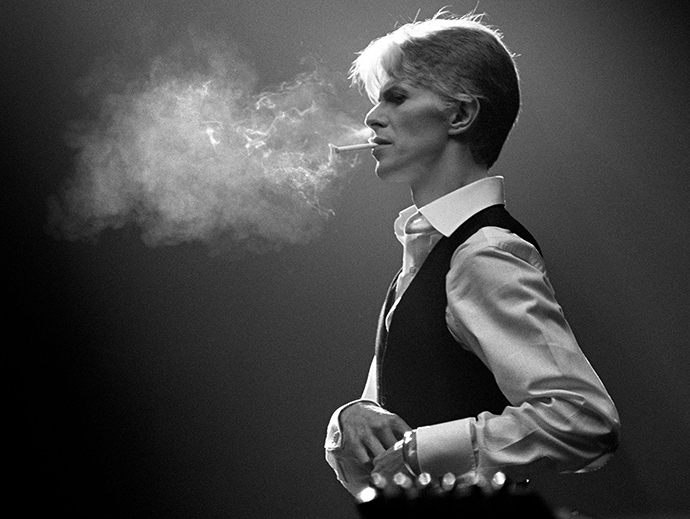
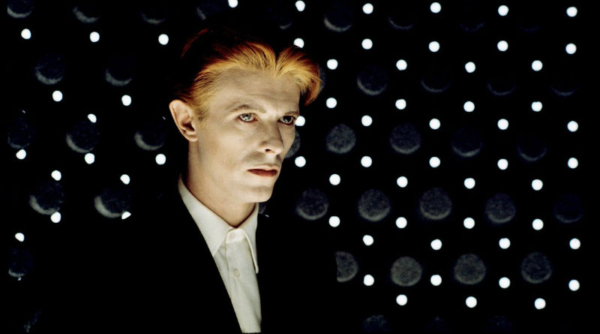
    Songs on Station to Station include “Golden Years”,”Stay” (terrific guitars from Alomar and Slick),”TVC 1-5″ ( Bowie said that the unused tune for the Man…Earth soundtrack was about a girl and her relationship with her television),”Wild is the Wind” (as soulful as anything on Young Americans   but without the affectation ), and the title song, often cited by post-punk bands including The Cars, Talking Heads, and Gary Numan as a major influence. My archival conversation here with the late David Bowie encompasses all of that plus much more on “Golden Years” golden anniversary. –Redbeard
  • David Bowie- Young Americans

    David Bowie- Young Americans

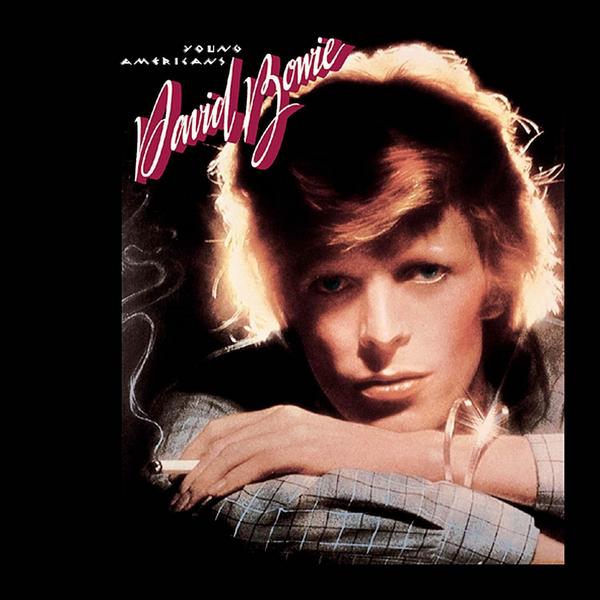
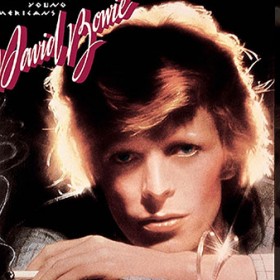
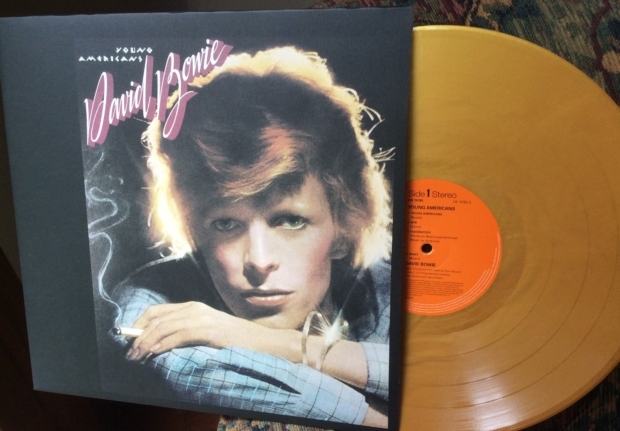
    “I was terrified of being trapped in that Ziggy Stardust character for the rest of my career,” David Bowie solemnly confessed to me In the Studio. So in early March 1975, Bowie executed a musical and visual image hard left turn, in homage to the vibrant soul music with which he had fallen in love while living in New York City then. The resulting albumYoung Americans contained the sweeping “Win”; the soulful “Somebody Up There Likes Me”, featuring the budding sax star David Sanborn (d. 2024) steaming like a Junior Walker acolyte; the huge hit with the John Lennon cameo, “Fame”; and the dance-floor flooding “Young Americans”. The late David Bowie from the In the Studio  classic rock interview archives marks the all-important career landmark Young Americans.

    By 1975 David Bowie had abandoned the Glam Rock he had virtually invented in the guise of the ego-tripping tragicomic fallen rock star Ziggy Stardust, first as New York City blue-eyed soul man, then the LA decadence of his Thin White Duke persona. David Bowie was rock’s Full Moon, irresistible in his pulling power, while the rest of the rock world was like the tide, following inexorably yet always lagging behind. But with Bowie’s mid-decade Young Americans  album with the #1 hit “Fame” and its John Lennon cameo pointing directly toward Disco’s dominance a mere two years later, hindsight clearly shows that the tide was rising quickly.

    Arguably, the sound of the Seventies may have dawned as early as August 1971 with Who’s Next,  or as late as April 1973 with Dark Side of the Moon. But with David Bowie’s June 1972 The Rise and Fall of Ziggy Stardust and the Spiders from Mars, not only did the exaggerated stereo and dry close-miked perspective make the sound of The Spiders seem to threaten to pierce the invisible barrier of your speakers, but Bowie’s hair, makeup, cross-dressing, and outrageous onstage behavior looked and acted like nothing we’d ever seen outside of a Frederico Fellini film festival. David Bowie took my assessment of the Seventies’ line of demarcation one better: “The Seventies really felt like a new century. The Sixties were a coda to the rest of the (20th) Century,” David stressed. “I think the Seventies showed conclusively that we live on a thread of rationality, that in fact the cosmos is far more complex and non-understandable than we had perceived. That everything we know is WRONG!” –Redbeard

  • David Bowie- Let’s Dance

    David Bowie- Let’s Dance

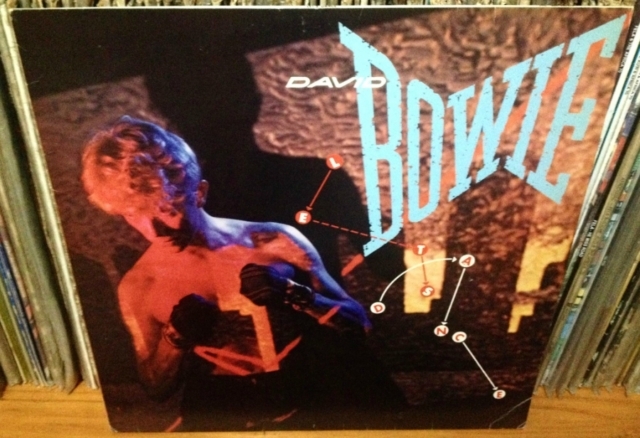
    Well before Let’s Dance by David Bowie came out in April 1983, we already knew  that rock’s original Moon Child could change sound, style, and musician personnel predictably like lunar phases. Granted, for the preceding four releases Bowie had been working with ex-Roxy Music innovator Brian Eno as producer on cutting-edge sounds in Berlin and, while later to be cited as highly influential by many others, their success in America was admittedly mid-chart.  Let’s Dance flipped that focus back to American roots with one listen.

    David Bowie’s most popular album Let’s Dance, a playful imperative released in April 1983, is one which Rolling Stone  magazine would later describe as “the conclusion of arguably the greatest 14-year run in rock history.”  Selling just under eleven million copies, the title song “Let’s Dance” was the #1 song in the US and UK, a first and only for David’s five decade career, while “Modern Love” and “China Girl” both reached #2 in his native England. And let us not forget that in mashing up the blues with the New Romantic sound, a musical style which ironically he himself had completely influenced with his Berlin trilogy of Heroes,  Low,  and Lodger,  David Bowie introduced us to then-unknown Texas guitar player Stevie Ray Vaughan on Let’s Dance.

    A lot has changed  since April 1983, not the least of which is in the areas of communication, information, and entertainment. So it was no surprise that multi-media maven David Bowie, who seemed tailor-made then for the dawn of the MTV era in America when Let’s Dance  was released, would later be among the first to embrace computer-generated gaming and virtual reality, which David discusses at length here. As much as fifteen years before he would be diagnosed and eventually succumb to liver cancer in January 2016, you will hear in this conversation that David Bowie felt that art is, in some ways, as effective as religion for some in helping to address life’s biggest questions.

    David Bowie’s birthday  in January 2018 saw the release of a previously unreleased treasure, the actual demo for the 1983 title song to Let’s Dance. Now we lovingly present the encore interview with the late icon for the  anniversary of that timeless album here In the Studio. But it was not the first time that David Bowie’s birthday  presented us with musical surprises.

    David Bowie’s first new album in almost a decade, The Next Day,  was kept completely under wraps ever since his 2004 heart attack while on tour in Germany, dropped without any notice in 2015,  and the reaction was unequivocally and universally positive. Remarkably free from artifice or trend, The Next Day  was brimming with seventeen new songs framed by Ziggy-era producer Tony Visconti’s straightforward production in a way that focused attention on Bowie’s concise songcraft, wisely limiting the arrangements to nothing over four minutes. Then we had yet another new Bowie trove, Blackstar, arriving  on his birthday in 2016. But these were far from David Bowie’s first “comebacks”. In the late 1970s he emerged from a protracted period of self-imposed exile in Berlin where he had virtually  co-opted the best elements of Kraut Rock (Kraftwerk, Tangerine Dream, Can, Amon Duul ) into a series of critically lauded if not best-selling albums Low, Lodger, Heroes, and Scary Monsters, whose influence can now be seen in full bloom in today’s wildly popular Electronica raves.

    When Bowie’s Let’s Dance  emerged in Spring 1983, the seven minute title strut put David back in heavy rotation on North American rock radio where he had been MIA since his previous “comeback” to rock, 1976’s #1 seller Station to Station. Sitting with David Bowie In the Studio in his beloved New York City, just twelve hours after he had thrilled a packed Kit Kat Club with an electrifying  performance streamed live on the burgeoning World Wide Web back in November 1999, he glides and pirouettes through a myriad of topics while sharing “China Girl”(co-written with Iggy Pop),”Modern Love”,”Criminal World”, “Cat People”, and “Let’s Dance” featuring a young previously unknown Texas blues (!) guitarist named Stevie Ray Vaughan.

    Wrestling with the reality of continuing in a world without the living presence of David Bowie is rendered a whole lot easier these days as we honor him with this in-depth one-on-one conversation In the Studio to celebrate Let’s Dance. Shall we? –Redbeard 
    </em

  • David Bowie- Rise and Fall of Ziggy Stardust…- the late David Bowie, Mick Ronson

    David Bowie- Rise and Fall of Ziggy Stardust…- the late David Bowie, Mick Ronson

    In Summer 1972, London lad David Bowie’s extra-terrestrial album The Rise and Fall of Ziggy Stardust and the Spiders from Mars invaded the rock and roll world like Orson Welles’ notorious Halloween broadcast thirty-three years earlier. And while the reaction may have been not as swift, the impression that was left certainly was astronomically wider. Even with the thousands of popular albums which have been released since the fourth David Bowie album landed in June 1972, Rolling Stone editors still rank The Rise and Fall of Ziggy Stardust and the Spiders from Mars at #40 on their Top 500 Albums of All Time. That places Ziggy Stardust… ahead of Led Zeppelin IVBorn in the USA, Who’s Next, Let It Bleed and Sticky Fingers, Achtung Baby, Dark Side of the Moon, Hotel California, The Doors, The Band, Guns’n’Roses Appetite for Destruction, AC/DC Back in Black, Meet the Beatles and Let It Be.  Are you feelin’ me?

    The Rise and Fall of Ziggy Stardust and the Spiders From Mars  by David Bowie in 1972 sounded unlike any album before it, and precious few ever since. As you will hear in this classic rock interview  with Bowie  and the late guitarist/arranger Mick Ronson, the irony in the David Bowie back story is that Ronno points out that the Ziggy Stardust… album and U.S. tour in Summer 1972 did not sell very well, at least not initially, which Ziggy Stardust… producer Ken Scott confirms in his 2012 memoir Abbey Road to Ziggy Stardust.  “While many of the initial dates were indeed successful, Bowiemania had not taken hold in all parts of the country, as dates in Houston and Oklahoma City were cancelled due to lack of ticket sales, and a concert in St.Louis had attendance so small (only 180 in an 11,000-seat hall) that David gave what amounted to a private show. But as the tour progressed, so did the buzz. By the second time back in cities such as Philadelphia and Cleveland, he (Bowie) was selling out 10,000-seat venues,” Scott writes in Abbey Road to Ziggy Stardust.

    In the Studio writer emeritus and New York Times contributor Joe Rhodes opines that “this album is a more successful combination of the elements of rock and theater than had ever been attempted. As rock fable, the story of stardom and its capacity for self-destruction, Ziggy Stardust… worked much better than The Who’s Tommy”, with the late David Bowie changing the trajectory of rock music, fashion, and gender social issues in the ensuing fifty years in just 38 minutes. – Redbeard