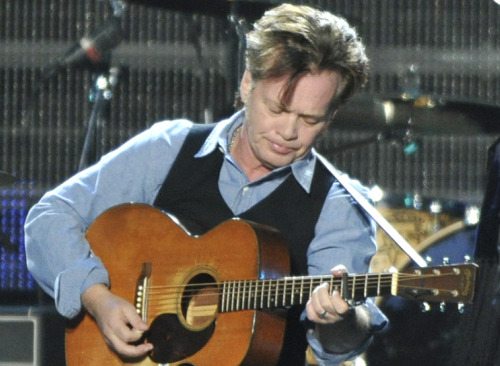
Here is John Mellencamp’s live acoustic performance of “Pink Houses” on my Dallas/ Ft.Worth Q102 radio show 10-1-91 with Mike Wanchic on acoustic guitar & harmonies and the great Kenny Aronoff on tambourine. It came out so good that John Mellencamp’s record label asked to release it as a CD single in Europe in 1992. Don’t miss the fortieth anniversary interview about Uh Huh with John Mellempcamp here In the Studio next week starting 11/13. –Redbeard
Tag: 1983
-

YES- 90125- Jon Anderson,Trevor Rabin,Tony Kaye, the late Chris Squire & Alan White
Seventies progressive rock titans YES, thought to be left washed up on the deserted beach of some topographic ocean almost forty-five years ago, reunited the twin towers that founded the band, Jon Anderson and Chris Squire at the eleventh hour, with YES prodigal keyboard player Tony Kaye, drummer Alan White, and youngblood South African singer/songwriter/guitarist Trevor Rabin to craft 90125, easily the comeback story of the Eighties. The return of progressive rock franchise YES in Autumn 1983 with the modern, slick 90125 was highly improbable, and the story is one of the great reinventions in all of rock history.YES had always consisted of musicians with exceptional “chops”. In more than fifty years they had at least a dozen different line-ups, and almost double that many individual members counting touring musicians. Seeing YES perform in the round Fall 1978 in Memphis included YES co-founding singer/bass player the late Chris Squire, guitarist Steve Howe, drummer the late Alan White, keyboard player Rick Wakeman, and YES co-founding singer nonpareil Jon Anderson. Yet a scant three years later, amidst the Post-Punk churn of a wholesale turnover in many of Progressive Rock’s most popular bands, YES was gone, one of the several iconic Seventies sacred cows ingloriously slaughtered and sacrificed upon punk rock’s burning altar.

The talented rhythm section of Squire and White kept in touch into 1982, when they came tantalizingly close to forming a supergroup with another legend “on the beach” at the same time, Jimmy Page of the defunct Led Zeppelin, calling themselves XYZ. Page would bow out after two months of rehearsal, but Squire and White kept working under the name Cinema, seeking to find a suitable songwriter/guitarist/ singer. Management suggested a young handsome talented South African, Trevor Rabin, who came from a serious classical music family and who had wood-shedded a number of strong songs in search of a suitable band. Then they reconnected with original YES keyboard player Tony Kaye, as well. As Cinema, by midpoint 1983 their recordings were near enough completion that Chris Squire was eager to play what he believed to be their new album to his former musical partner since art school, Jon Anderson.
Then something remarkable happened. It resulted in more than eight million copies selling worldwide from a musical entity thought to be extinct, but with the songs “It Can Happen”,”Hold On”,”Leave It”,”Changes”, and the #1 hit “Owner of a Lonely Heart”, YES could rise like a musical phoenix from the ashes of the progressive rock Seventies with the comeback album of the Eighties in 90125 (not a Beverly Hills zip code, but simply the album catalog number). Rabin, prodigal son Kaye, Jon Anderson, the late Alan White and Chris Squire…they’re all here In the Studio with these classic rock interviews on 90125’s fortieth anniversary.(L-R standing: AlanWhite,Trevor Rabin,Tony Kaye; seated front left Jon Anderson, the late Chris Squire )
This episode of In the Studio is dedicated to YES drummer Alan White who died suddenly May 26, 2022. Alan was a musician with a resume second to none, playing with John Lennon on “Instant Karma”,”Imagine”, and “Jealous Guy”, and George Harrison on All Things Must Pass including “My Sweet Lord”, before replacing Bill Bruford on the Close to the Edge tour. Alan White was a soft-spoken gentle soul, a real sweet guy, and it’s a real loss. –Redbeard
-

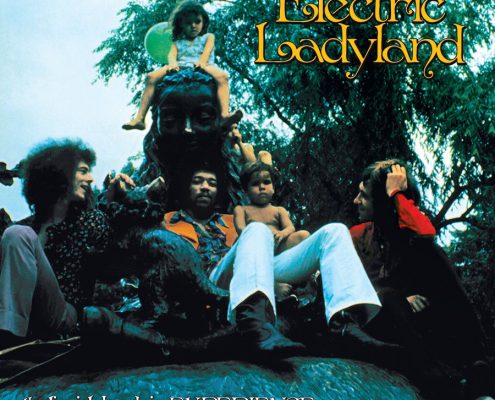
Jimi Hendrix Experience- Electric Ladyland pt2- Mitch Mitchell, author John McDermott
Jimi Hendrix and his British trio the Experience created a landmark double album in 1968 called Electric Ladyland, but now this deep into the 21st century it may be difficult for many to fully understand the context in which it was made and the world into which it was subsequently released. When Hendrix had been “discovered” by Animals bass player Chas Chandler only two years earlier in a New York City Greenwich Village club on the equivalent of “open mic night”, Jimi was fresh off the chitlin circuit purely as an anonymous sideman. After relocating to London with the veteran Chandler as mentor/co-manager/producer, Hendrix released two game-changing albums before returning back to America.
But as you will hear in the conclusion of this classic rock interview with biographer/ reissue producer John McDermott plus one of the last interviews with Jimi Hendrix Experience drummer Mitch Mitchell, neither Chandler nor Experience bass player Noel Redding were on board with the change. Hendrix’s joy to be back is apparent in his embrace of many formative musical influences including soul, rhythm and blues, and jazz, but the fact that the April 1968 assassination of the leader of the American civil rights movement, the Rev. Dr.Martin Luther King jr, which had touched off violent race riots across many major U.S. cities, shattered any naivete that here was an African-American leading an otherwise all white band on tour across the U.S., including the heavily segregated South, during the most violent year in America since World War II. –Redbeard -

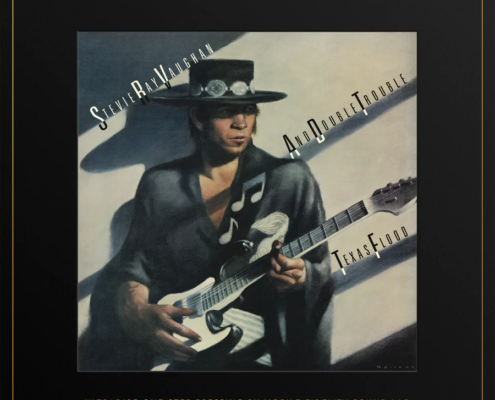
Stevie Ray Vaughan & Double Trouble- Texas Flood
The authentic sawdust-on-the-floor, rough and tumble rhythm and blues that I discovered on a little white promo cassette labeled “Stevie Ray Vaughan & Double Trouble Texas Flood” was in stark contrast to other new music in Spring 1983 by U2, Talking Heads, and David Bowie that we were programming on ROCK 103/Memphis . When I heard the joyful shuffle of “Pride and Joy” by this Lone Star trio, I knew immediately that Stevie Ray Vaughan mined a deep vein of music which ran under everything that had come from Tennessee, Arkansas, and Mississippi, down to the Delta and west across Louisiana to East Texas, for over a hundred years.It takes a big cast to tell the origin story of Texas Flood from Stevie Ray Vaughan & Double Trouble, so join drummer Chris Whipper Layton, Double Trouble bass player Tommy Shannon, bluesmaster Buddy Guy, singer/songwriter the late Doyle Bramhall, biographer Joe Nick Patoski, and my archival interview with the late Stevie Vaughan for the headwaters of Texas Flood.
The songs featured include “Pride and Joy”,”Cold Shot”, the spectacular Hendrix cover”Voodoo Child”,”Look at Little Sister”,”Life Without You”, and two “Big” Doyle Bramhall songs, “Change It” and “Life By the Drop”.
For additional insight I recommend Joe Nick Patoski and Bill Crawford’s definitive biography Stevie Ray Vaughan : Caught in the Crossfire. Then for a more “family style” perspective, be sure to watch director Kirby Warnock’s 2019 documentary film, now retitled Jimmie & Stevie Ray Vaughan: Brothers in Blues, streaming on Amazon Prime. -Redbeard -

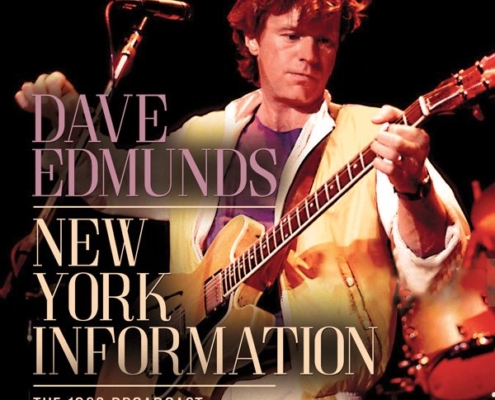
Dave Edmunds- I Hear You Knockin’- NYC 5-18-83
At the dawn of the Eighties, veteran English roots rocker Dave Edmunds had upped his profile as one of the twin frontmen of Rockpile, along with fellow countryman Nick Lowe. So when that ultimate Pub Rock band disbanded, Dave Edmunds resumed his solo career but kept Rockpile guitarist Billy Bremner with him on this superb live performance at New York City’s Roseland Ballroom in May 1983. –Redbeard

-

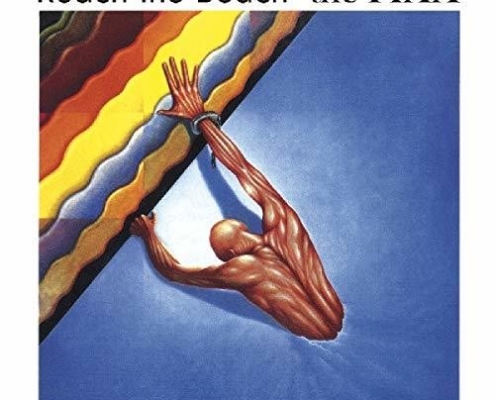
The Fixx- Reach the Beach- Cy Curnin, Adam Woods
“The backstage party at Woodstock had turned really mushy by then,” joked London’s The Fixx lead singer/songwriter Cy Curnin, by way of contexting their second album, Reach the Beach and the dawn of the Eighties musically.”You know, the backstage passes had been picked up (figuratively) laying around outside. ‘I finally got my backstage pass to Woodstock!’ And it’s six years later.” The Fixx drummer Adam Woods chimes in about why Punk Rock and its post-punk progeny like The Fixx had to happen. “But the main problem was it (the rock elite) was inaccessible. There was no way we were going to be able to join that spirit that the Woodstockers had. They were an exclusive club that you couldn’t get into. So I think a musical movement started that was outside the club door, where if you’re going to have a membership problem, all the good stuff’s going to be out in the street.”Reach the Beach by The Fixx was a remarkably strong two-million seller in its time, spawning “One Thing Leads to Another”(#4 on Billboard),”Saved by Zero”, “Sign of Fire”, and yet remains a seemingly under-appreciated album when discussing that period today. By definition, contemporary music is conceived, expressed, and thereby influenced by the condition of the world in which it finds itself. It is safe to say that the transition from the end of the 1970s decade into the dawn of the Eighties was marked in most things by the inexorable forces of change being met head on by the enormous resistance of intransigence and intractability, like two tectonic plates trying to occupy the same space. And as so often is the case, the most striking manifestation of that geopolitical fault line between the past and the future may have been evident in the world of early Eighties music.
Reflecting back on their 1982 debut Shuttered Room and its 1983 multimillion-selling follow up, Reach the Beach, Londoners Cy Curnin and Adam Woods of The Fixx reminded us that the loud, brash, but brief Punk Rock purge had successfully shaken the rock Brahmins out of their collective bloated complacency by the Eighties. But the Punks did not tell rock where to go next. Songs including “Stand or Fall”, “Red Skies at Night”,”Saved By Zero“, the #4 US hit “One Thing Leads to Another”,”Deeper and Deeper”, and “Are We Ourselves“ all have proven to be remarkably “Built for the Future“. (This episode of In the Studio dedicated to Raymond McGlamery).- Redbeard -

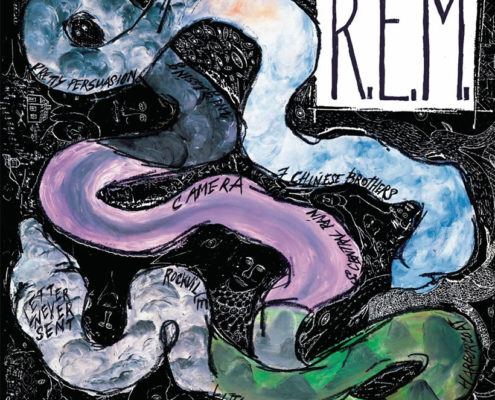
R.E.M.- Murmur/Reckoning- Michael Stipe, Peter Buck
My conversations with R.E.M. lead singer/songwriter Michael Stipe and lead guitarist/co-writer Peter Buck about their first two full length albums, Murmur and Reckoning, reveal a band remarkably cohesive and certain about its vision from the start. My interviews include the earliest days of the Athens, GA R.E.M. with songs from their first three full albums, Murmur (a perennial “desert island disc” for me, released April 1983); Reckoning a year later and peaking at #27 on Billboard; and then Fables of the Reconstruction. “We played for $40 a night for years,” R.E.M. guitarist Peter Buck says matter-of-factly. “There were many $8 nights. Yet we never lost money on a tour. We’d always start in Athens GA, and make $800. And then we’d go to North Carolina and make $300. Then when we got out of that area, we’d open for somebody and they’d give us $50 or $100 to open for Bow Wow Wow in Detroit.”
R.E.M. Murmur quietly emerged April 12, 1983 and has never left my essential music list, along with its follow-up Reckoning over forty years ago. Songs here include “Radio Free Europe”,”Pilgrimmage”, “Talk About the Passion”, “South Central Rain”, “Pretty Persuasion”, “Can’t Get There from Here”,”Driver 8″, and an ultra-rare live acoustic performance of “Maps and Legends” from McCabe’s Guitar Shop in Santa Monica.
Murmur peaked on Billboard sales chart at #36 initially, but has only grown in esteem ever since. Rolling Stone magazine declared it their pick for Best Album in 1983; then #8 on their 100 Greatest Albums of the Eighties; #18 on the 100 Best Debut Albums; and on Rolling Stone‘s most recent 500 Greatest Albums of All Time, Murmur by R.E.M. sits at an impressive #165. This edition of In the Studio lovingly dedicated to the memory of Barney Kilpatrick, who tirelessly promoted all of these early albums for R.E.M.- Redbeard -

David Bowie- Let’s Dance
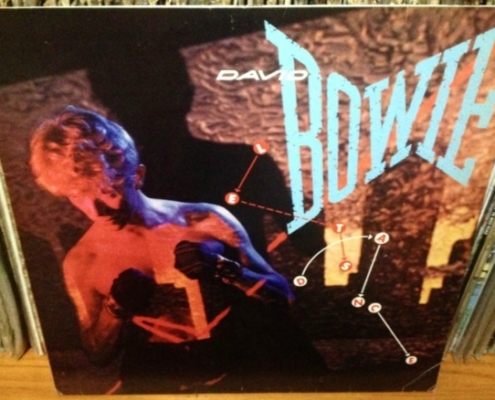
Well before Let’s Dance by David Bowie came out in April 1983, we already knew that rock’s original Moon Child could change sound, style, and musician personnel predictably like lunar phases. Granted, for the preceding four releases Bowie had been working with ex-Roxy Music innovator Brian Eno as producer on cutting-edge sounds in Berlin and, while later to be cited as highly influential by many others, their success in America was admittedly mid-chart. Let’s Dance flipped that focus back to American roots with one listen.David Bowie’s most popular album Let’s Dance, a playful imperative released in April 1983, is one which Rolling Stone magazine would later describe as “the conclusion of arguably the greatest 14-year run in rock history.” Selling just under eleven million copies, the title song “Let’s Dance” was the #1 song in the US and UK, a first and only for David’s five decade career, while “Modern Love” and “China Girl” both reached #2 in his native England. And let us not forget that in mashing up the blues with the New Romantic sound, a musical style which ironically he himself had completely influenced with his Berlin trilogy of Heroes, Low, and Lodger, David Bowie introduced us to then-unknown Texas guitar player Stevie Ray Vaughan on Let’s Dance.
A lot has changed since April 1983, not the least of which is in the areas of communication, information, and entertainment. So it was no surprise that multi-media maven David Bowie, who seemed tailor-made then for the dawn of the MTV era in America when Let’s Dance was released, would later be among the first to embrace computer-generated gaming and virtual reality, which David discusses at length here.
As much as fifteen years before he would be diagnosed and eventually succumb to liver cancer in January 2016, you will hear in this conversation that David Bowie felt that art is, in some ways, as effective as religion for some in helping to address life’s biggest questions.David Bowie’s birthday in January 2018 saw the release of a previously unreleased treasure, the actual demo for the 1983 title song to Let’s Dance. Now we lovingly present the encore interview with the late icon for the anniversary of that timeless album here In the Studio. But it was not the first time that David Bowie’s birthday presented us with musical surprises.
David Bowie’s first new album in almost a decade, The Next Day, was kept completely under wraps ever since his 2004 heart attack while on tour in Germany, dropped without any notice in 2015, and the reaction was unequivocally and universally positive. Remarkably free from artifice or trend, The Next Day was brimming with seventeen new songs framed by Ziggy-era producer Tony Visconti’s straightforward production in a way that focused attention on Bowie’s concise songcraft, wisely limiting the arrangements to nothing over four minutes. Then we had yet another new Bowie trove, Blackstar, arriving on his birthday in 2016.
But these were far from David Bowie’s first “comebacks”. In the late 1970s he emerged from a protracted period of self-imposed exile in Berlin where he had virtually co-opted the best elements of Kraut Rock (Kraftwerk, Tangerine Dream, Can, Amon Duul ) into a series of critically lauded if not best-selling albums Low, Lodger, Heroes, and Scary Monsters, whose influence can now be seen in full bloom in today’s wildly popular Electronica raves.When Bowie’s Let’s Dance emerged in Spring 1983, the seven minute title strut put David back in heavy rotation on North American rock radio where he had been MIA since his previous “comeback” to rock, 1976’s #1 seller Station to Station. Sitting with David Bowie In the Studio in his beloved New York City, just twelve hours after he had thrilled a packed Kit Kat Club with an electrifying performance streamed live on the burgeoning World Wide Web back in November 1999, he glides and pirouettes through a myriad of topics while sharing “China Girl”(co-written with Iggy Pop),”Modern Love”,”Criminal World”, “Cat People”, and “Let’s Dance” featuring a young previously unknown Texas blues (!) guitarist named Stevie Ray Vaughan.
Wrestling with the reality of continuing in a world without the living presence of David Bowie is rendered a whole lot easier these days as we honor him with this in-depth one-on-one conversation In the Studio to celebrate Let’s Dance. Shall we? –Redbeard
</em -

ZZ TOP- Eliminator- Billy Gibbons, Frank Beard, the late Dusty Hill
Prior to the March 1983 release of ZZ Top’s Eliminator, it’s not like the Texas trio had been struggling or anything. Billy Gibbons, Dusty Hill, and Frank Beard had been releasing albums and touring for over a decade, and Gibbons had been elevated among the rock world’s most prestigious guitar players as a wholly original and immediately identifiable Tone Monster. But Eliminator, with its four Top Twenty hits, modern ear candy updated production, and campy, quirky videos blanketing the new 24-hour video channel MTV then, was a flat-out international phenomenon.Up to ZZ Top’s March 1983 release Eliminator, one of my secret weapons at making ROCK 103 the top-rated radio station in Memphis from 1980 through 1983 was the friendship that developed with the late legendary studio owner John Fry and his wonderfully talented staff at the world-renowned Ardent Studios nearby. As it turned out, one of my personal favorite bands, Houston-based ZZ Top, had discovered the high caliber, low key facility as early as their 1973 breakthrough album Tres Hombres, and in typical Bill Ham style ( the band’s colorful longtime manager and producer who passed away in 2016), “if it ain’t broke, don’t fix it”. So ZZ Top proceeded to make every subsequent album there with ace Ardent recording engineer Terry Manning, with titles en Espanol including Fandango, Tejas, DeGuello, and El Loco.
By February 1983, ROCK 103’s owner decided to reinvest some of the record revenues back into the facility with a major control room studio update, complete with new broadcast console, electronics, and JBL monitors. When I mentioned this fact to ZZ Top’s veteran recording engineer Terry Manning, he replied,”Before you go ‘live’ to broadcast with your new studio, would you allow me to play the master mix of the unreleased ZZ Top album in there?” I could not believe my good fortune!
Terry arrived with two large metal reels of tape, loaded them onto the pristine new Studer reel machines, and pushed the “play” button. What happened next absolutely blew me away: “Gimme All Your Lovin’ “, followed in rapid succession by “Got Me Under Pressure” and “Sharp Dressed Man” played at about rock concert sound level, left me in sensory boogie overload. It was just too good to absorb the sonic banquet that ZZ Top was serving up. And just when I begged “Have mercy!” to break from the intensity of Billy Gibbons’ feedback-soaked “squanking” guitar, the late Dusty Hill’s propulsive bottom end, and Frank Beard’s in-the-pocket drumming, the song sequence shifted to the cascading midnight blues of “Need You Tonight”; the Dusty raunchy rave up “I Got the Six”, the international hit “Legs”, and the grinding smoldering groove of “TV Dinners”.
In just a few weeks the rest of the world would soon discover what I had experienced that day, responding by purchasing over 15,000,000 copies of Eliminator worldwide. And yes, the series of clever, campy videos on the upstart MTV video channel in America undoubtedly had much to do with that staggering level of popularity (truly ironic, since manager Ham had steadfastly kept ZZ Top off of U.S. television until then). But the songwriting, musicianship, modern arranging, and state-of-the-art recording on Eliminator which I first heard March 1983 was truly extraordinary.
(Backstage in Grand Prairie TX November 2007 front row L-R Billy Gibbons, Redbeard, Frank Beard, the late Dusty Hill )ZZ Top’s Billy Gibbons and Frank Beard are my guests here In the Studio to document “Gimme All Your Lovin’ “,”Got Me Under Pressure”,”Sharp Dressed Man”,”Legs”, “TV Dinners”, the smoldering blues “I Need You Tonight”, and of course I will share my archival interview with the late rave-up singing bass player, Dusty Hill, in tribute. -Redbeard
-

ZZ Top- Sharp Dressed Man- Los Angeles
ZZ Top with the incredibly durable original tres hombres of the late bass player Dusty Hill, drummer Frank Beard, and squankmaster Billy Gibbons taking a turn on the Hollywood red carpet with “Sharp Dressed Man” in concert in the City of Angels. –Redbeard