
Tag: Ian Anderson

  • Jethro Tull- Locomotive Breath- Philadelphia 1987
    Jethro Tull- Locomotive Breath- Philadelphia 1987

    Forced to not sing a note for three long years due to a chronic throat infection, Ian Anderson took the layoff to write Jethro Tull’s strongest batch of songs in the Eighties for 1987’s Grammy-grabbing album Crest of a KnaveThe supporting tour that year found Anderson and Jethro Tull never sounding better, as you can hear from this live performance of “Locomotive Breath” from the perennially evergreen classic Aqualung, now sporting its double-nickle anniversary. -Redbeard


  • Jethro Tull- Aqualung 55th Anniversary- Ian Anderson

    Jethro Tull- Aqualung 55th Anniversary- Ian Anderson

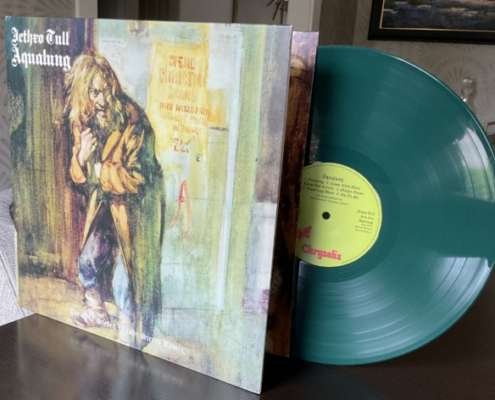
    Every real rock music fan has a shortlist of essential albums which were more than mere entertainment, and mine includes Jethro Tull’s March 1971 fourth album, Aqualung. Since then, I’ve never thought the same way about religion, homelessness, or one-legged flute players in tights. Fifty-five years later, Ian Anderson’s lyrical subject matter of sectarian religious wars (“My God”, “Locomotive Breath”), cruel shallowness of male predation (“Cross-Eyed Mary”), and cold indifference to society’s needy (“Aqualung”) keeps the album Aqualung remarkably evergreen in its relevancy on its double nickel anniversary. But, sadly, it doesn’t say much for human nature.

    Ian Anderson’s house is haunted. Or at least the Jethro Tull leader has good reason to believe that it’s haunted. Sitting in the dining room of the very old but modern-updated “Bucks” home in the English countryside for my interview regarding March 1971’s Aqualung  album, we shared in  common the fact that we both live and record on working farms just outside major cities, Anderson’s less than an hour west of London. The current house was built more than three centuries ago on the ruins of a nunnery plundered by Oliver Cromwell during the mid-17th century English military/political leader’s genocidal campaign against Catholics. In my classic rock interview, Ian told me that there are historical accounts of the nuns being raped before they were murdered by Cromwell’s troops, which could explain the curious reactions of certain visitors to Anderson’s isolated home over the years.

    It seems that without any knowledge of the home’s history, one popular British comedian became convinced during a visit that intensely strong paranormal vibrations were emanating from beneath the house, while on another separate occasion a female guest stayed but a minute before running from the house in hysterics. Anderson’s lovely wife claims on occasion, in broad daylight, to see a white horse running up the stairs, which one would surmise could present a problem getting good domestic help. And while Ian himself has never witnessed that specter, once he did glance up into a wall-mounted mirror, the angle of which  allowed him to see  into  their downstairs laundry room.  There he  observed clearly the back of a dark-haired young woman dressed in an ancient gray robe. Thinking it was his wife, Anderson called out to her but received no response. When he entered to peer into the laundry room, no one was there.
    The moral of this story? Don’t expect anyone to volunteer to help you with laundry in the next world, either.Meanwhile, few albums from any time in the Rock Era continue  to satisfy quite so well as Jethro Tull’s masterpiece Aqualung.  Ian Anderson smartly wrote songs for all seasons for a superb band, including the timeless rockers “Aqualung”,”Cross-Eyed Mary”,”Locomotive Breath,” and “Hymn #43”, but perfectly paced the album with tasty acoustic classics like “Wond’ring Aloud”and “Mother Goose”. And the Steven Wilson (Porcupine Tree) remix and 21st Century remastering results in a stunning listening experience even fifty-five years later.

    Ian Anderson is my guest In the Studio with insights and revelations in this classic rock interview concerning Jethro Tull and Aqualung. -Redbeard

  • Jethro Tull- Best pt 2- Ian Anderson

    Jethro Tull- Best pt 2- Ian Anderson

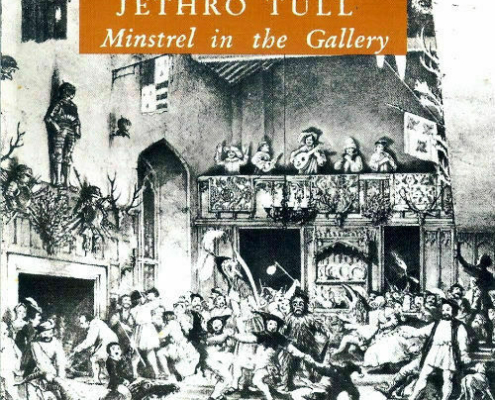
    The first decade of Jethro Tull’s half century, occupying that musical territory only big enough for itself, where ancient-sounding heath-covered acoustic numbers combine with sprawling progressive rock, fits neatly with the period after the debut, This Was, all the way to Heavy Horses ten years later. Jethro Tull  and its singer/songwriter/flautist Ian Anderson were fearless in those heady days, going to #1 sales with the most unlikely chart-topper since The Singing Nun, 1972’s Thick as a Brick;   brushing off the disastrous A Passion Play, then coming back strong with two Top 40 hits on War Child. Minstrel in the Gallery,  Too Old to Rock’n’Roll,  and Songs from the Wood  all followed in regular succession.


    But beginning in 1979 and continuing all the way until the late Eighties, Jethro Tull’s fate and fortunes would be quite unlike their first decade of success. Bass player John Glasscock died from heart surgery just five weeks after Stormwatch‘s 1979 album release, a tough blow, and to add insult to injury, the album was the first Jethro Tull effort since the 1968 debut not to reach the US Top 20 in sales. The Broadsword and the Beast  in 1982 easily could have been the theme for the HBO hit series Game of Thrones, albeit written thirty years too soon. Jethro Tull certainly were not alone, as many of their Seventies peers struggled as they did then amidst Pop Metal hair bands of the MTV Eighties that were selling millions of records and hair mousse by the gallon. But after an eight year drought, Jethro Tull had all of the tumblers click on the 1987 album Crest of a Knave  containing”Farm on the Freeway,”Steel Monkey”, andBudapest“, a Top 20 seller in the UK and #3 in the States, eventually winning a Grammy Award and reigniting concert ticket and further album sales for Rock Island  in 1989 and Catfish Rising  in 1991. Selecting the fifty songs over the twenty-one studio offerings for the 50 for 50 massive undertaking proved a challenge for Ian Anderson to curate, not simply for fan expectations. If there ever was a lyrical wordsmith who learned his songwriting trade in the widescreen cinematic tradition of the album format, and who is ill-suited for the one-song You Tube world he found himself in fifty years hence, it would be Ian Anderson. “If it’s all too much for you, if you’d rather sit down and watch an episode of The X Factor,  be my guest,” Anderson snarks in this classic rock interview as to why album sales are down. “But on the other hand, if you want something that is an antidote to that fast food music we seem to live amidst these days, then maybe this is the album for you. You can get your teeth into it, while you still have any, that is! We snack on music these days. We don’t sit down to a banquet and take two hours over it, we tend to snack. So it is a change in culture I have to recognize.” –Redbeard

  • Jethro Tull- Minstrel in the Gallery/Songs from the Wood- Ian Anderson

    Jethro Tull- Minstrel in the Gallery/Songs from the Wood- Ian Anderson

    Discussing Jethro Tull’s Minstrel in the Gallery, I am reminded that the life of an internationally successful legacy rock band leader, such as my guest Ian Anderson, requires not just business acumen but even the skills of a roving diplomat doing shuttle diplomacy. “Knowing a bit about Russia historically, and also having been there to perform several times, I’ve had a long association with Russia and a respect for the Russian people,” Jethro Tull’s Ian Anderson admitted, “and I do have a grudging respect for (President) Vladimir Vladimirovich Putin, because in many ways he’s a very canny, clever guy. He has all of the hallmarks of an international statesman, yet he’s made a decision (invading Ukraine) that I believe is the WRONG one…He’s just putting himself in a place where he will be reviled forever.”

    “I met Putin,” Anderson continues. “He was actually the right-hand man economic advisor to Anatoly Sobchak, the mayor of St. Petersburg around 1991-92. And he came to a Jethro Tull concert and we met him backstage. There is a photograph of me talking to Mayor Sobchak, and right on the edge of the photo you see this stern-looking evil face staring daggers at me. Putin didn’t like me talking to his boss.”

    “Prolific” doesn’t even begin to describe the massive musical output of Ian Anderson and Jethro Tull, and this fact becomes immediately obvious when you realize that Minstrel in the Gallery, released fifty yeas ago, and Songs from the Wood, released in February 1977, were already the English folk/progressive rocker’s ninth and tenth albums. There was nothing then that sounded remotely like the ancient pastoral songs and instrumentation on Minstrel in the Gallery and Songs from the Wood playing on the all-important American rock radio, and in spite of sounding so different (or maybe, as my guest Ian Anderson contends, because of it), Songs from the Wood became one of Jethro Tull’s bestsellers, peaking at #8 in sales on Billboard.


    By 1977 Jethro Tull was one of the biggest concert draws in the rock world, but for the five years preceding had alternately delighted their fans and music critics alike (Thick as a Brick, War Child) or confounded them (Passion Play; Too Old to Rock and Roll, Too Young to Die). September 1975’s Minstrel in the Gallery and 1977’s Songs from the Wood (not to be confused with Songs from the ‘hood by Deathrow Tull, which would be a “heavy horse of a different colour” ) were so far afield from mainstream rock that it was refreshing, vibrant, impeccably played and arranged, and a stellar recording that tickles the ear to this day. Musical chestnuts include “Cold Wind to Valhalla”, “One White Duck”, the knees-up rocker “Minstrel in the Gallery”, “The Whistler”,”Velvet Green”,  and “Songs from the Wood”. Ian Anderson of Jethro Tull is my guest In the Studio  to regale us. –Redbeard
  • Jethro Tull- Benefit @55- Ian Anderson

    Jethro Tull- Benefit @55- Ian Anderson

    April 1970’s third Jethro Tull album, Benefit, was my gateway drug into a lifelong relationship with the music and mind of Ian Anderson. Songs including “With You There to Help Me”, “Nothing to Say”, “To Cry You A Song”, and “Teacher” all benefited (sorry) from the addition of John Evan on piano and mellotron, and from a more assertive approach on lead guitar from Martin Barre. The approach resulted in Benefit just missing Top Ten sales in America and an even more impressive #3 in Jethro Tull’s native UK. Ian Anderson tells some great stories to celebrate the double-nickel anniversary here In the Studio  for our collective benefit.

    This is the most highly-detailed oral history of Jethro Tull’s first formative years from the “Inside” by Ian Anderson that exists to our knowledge, with some stories he’s never previously revealed, such as why Mick Abrahams exited Jethro Tull after the debut This Was; how the late Joe Cocker was a messenger in Tull’s #1 success with Stand Up in the UK;  that neighbor John Evan was studying to be a pharmacist before Anderson enticed him to play keyboards on Benefit, sidetracking the would-be chemist; and which member of the band YES  wore paper underpants on tour!

    Many Americans, such as my lifelong friend to this day, attorney Bob Lyon of the Dallas Texas area, first saw Jethro Tull with me in Fall 1971 because of their soon-to-be-classic album release earlier that year, Aqualung. But they were the changes  in musical direction and key personnel made on Jethro Tull’s critical preceding third album Benefit,  in April 1970, that provided the oxygen in “Aqualung” ‘s  tank a year later, as you will hear in this exclusive classic rock interview with Jethro Tull’s Ian Anderson. -Redbeard

  • Jethro Tull- War Child- Ian Anderson

    Jethro Tull- War Child- Ian Anderson

    Even though I lived through it, still I must admit that it is hard to fully comprehend that the evolution in sound and success between Jethro Tull’s “underground” pastoral second album, Stand Up, and their mass appeal Top 40 breakthrough War Child, with the hits “Bungle in the Jungle” and “Skating Away (on the Thin Ice of a New Day)”, took a mere five years. In between those two aforementioned musical landmarks, Jethro Tull had also released the #1-seller in the world, Thick as a Brick! By 1969’s Stand Up, band co-founder Mick Abrahams had already left Ian Anderson to guide Jethro Tull’s sound, a role Anderson relished and never relinquished for half a century.

    “We were billed originally, around Blackpool and later London, as a blues band,” Anderson admitted to me,”except we were a terrible blues band. I certainly couldn’t sing it.” Never mind. In the years 1969-74 there was no band in the world more exciting, more unconventional, and more successful than Jethro Tull.

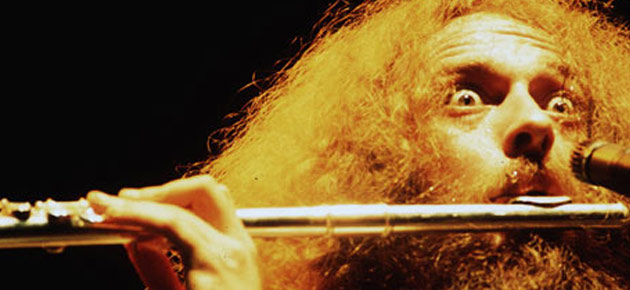
    With back-to-back albums Aqualung  in May 1971 and then the almost accidental #1 seller Thick As a Brick  in 1972, Jethro Tull combined pastoral acoustic guitar, flute, progressive rock arrangements, Martin Barre’s hard rock guitar bursts, and Ian Anderson’s dense thought-provoking lyrics into a heady brew which had no comparison. Originating in the northern English town of Blackpool, Jethro Tull was a name borrowed from the actual inventor of the seed drill. By 1968 they were as talked about as any of the new bands on the London club scene, primarily because of the stage presence of lead singer Anderson, whose leaping, scowling, bug-eyed mad hatter theatrics made for a great show. And then there was Ian’s choice of rock and roll “axe”: not a six-string six shooter like so many other bandleaders, but a 20th century Pan with a flute!

    The  box set of Jethro Tull‘s Songs from the Wood  received the knees up full Monty treatment from Porcupine Tree remixer/surround sound savant Steven Wilson, a perfect present for any long time Jethro Tull fan (is there any other kind?). In my opinion, the results from remixing Songs from the Wood  to surround sound are the most satisfying to date of all of the reissues so far including   Benefit , the 1970 Jethro Tull  under-appreciated missing link between the eclectic folksy Stand Up   and the breakthrough million sellers Aqualung  and Thick as a Brick.   Then there was the odds’n’sods collection Living in the Past which was rushed out in the U.S. in Fall 1972 to capitalize after Thick As a Brick  became Jethro Tull’s stunning #1 seller earlier that year. 

    Revisit the UK hit “Sweet Dream”, the band’s interpretation of Johan Sebastian Bach’s jaunty “Bouree”; “Teacher”; “Bungle in the Jungle” and “Skating Away…”, both from War Child ; and the title song to “Living in the Past”. And as you find yourself humming & singing all of these familiar melodies, either here in this classic rock interview or in concert, remind yourself that  Jethro Tull still is not in the Rock and Roll Hall of Fame. – Redbeard 

  • Jethro Tull- Stormwatch 45th Anniversary- Ian Anderson

    Jethro Tull- Stormwatch 45th Anniversary- Ian Anderson

    Revisiting Jethro Tull’s 1979 Stormwatch  for its forty-fifth anniversary in September proved to be surprisingly revelatory for me on multiple levels. First, the 2022 Steven Wilson remix of the music on Stormwatch revealed layers of voices and instruments in a fuller, more substantial presentation that were simply not evident on the original. In turn, the more seductive warmth lends several of the subjects and story lines, in songs such as “North Sea Oil”, “Something’s on the Move”, “Old Ghosts”, and “Dun Ringill”, more gravity.

    As it turns out, my guest Ian Anderson of Jethro Tull, in explaining the dual meaning of the Stormwatch title, may have been among the very first rock composers to observe the coming climate change, as well as the socio-political storms brewing in the former Soviet Bloc nations, Europe, and America. This was my first of many subsequent Ian Anderson interviews about Jethro Tull, and was conducted at ROCK 103 in Memphis back on Halloween 1979. Redbeard

  • Jethro Tull- Stand Up- Ian Anderson

    Jethro Tull- Stand Up- Ian Anderson

    “Well the biggest difference was that I was going to have to write all the songs this time,” quips Ian Anderson in a bit of understatement when I asked, in this classic rock interview, about the departure of Jethro Tull co-founder Mick Abrahams between their 1968 debut, This Was , and the much more successful Stand Up in July the following year. “We were billed originally, around Blackpool and later London, as a blues band,” Anderson told me, “except we were a terrible blues band. I certainly couldn’t sing it.” Never mind. Anderson would guide the unique sound and image of Jethro Tull with a firm grip and Rock of Gibraltar-like consistency, a role he relished and never relinquished for over fifty years.

    Ian Anderson was still trying to find his own voice and comfort level fronting Jethro Tull as they morphed, first from a not very good blues band “playing to only about twenty or thirty people in the pub”, Anderson admits, to an even worse soul band when they had to venture south to London for gigs. Ian’s nasal vocal affectation on “A New Day Yesterday” (no, not a Joe Bonamassa original, sorry) renders him almost unrecognizable now, but mercifully he settled in on the rest of Stand Up  including “Look Into the Sun”, “Nothing is Easy”, “We Used to Know”, the Bach flute instrumental “Bouree”, and the single Anderson composed at his managers’ insistence for the UK while Jethro Tull were touring America, “Living in the Past”. –Redbeard

  • Jethro Tull- Living in the Past- Philadelphia 1987
    Jethro Tull- Living in the Past- Philadelphia 1987

    Bob Carr Performing Arts Centre, Orlando, Fla.

    “Here’s a song we loathed for fifteen years!” winked Jethro Tull singer/songwriter/flautist Ian Anderson when introducing the song “Living in the Past” from the stage. The song is a bit of an orphan, written and recorded in 1969 between their second album, Stand Up, and the follow-up, Benefit, but appearing on neither one.

    The song’s composer, Ian Anderson, shares the annoyance of being told to go write a hit for the mainstream audience of the day, and the grudging success when “Living in the Past” had chart success…twice…when Anderson is my guest next week here In the Studio. –Redbeard

  • Jethro Tull- Thick As a Brick- Ian Anderson

    Jethro Tull- Thick As a Brick- Ian Anderson

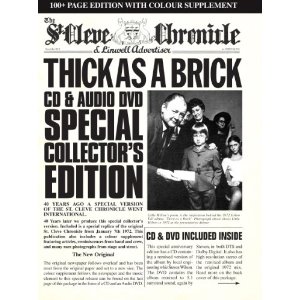
    Unquestionably and uniquely in a category all its own, Jethro Tull’s 1972 epic Thick As a Brick  is the only album in music history to attain #1 sales on Billboard containing only one song, albeit 43 minutes long! And as you will hear in this classic rock interview with my guest  composer/singer/flautist Ian Anderson, Thick As a Brick‘s ultimate irony  is that the album was conceived by Anderson as a total spoof of music critics purporting to ascribe imaginary meaning to Jethro Tull’s preceding Aqualung   album, as well as a send up of rock’s progressive darlings at the time.

    Redbeard:   As I was going back and researching our many previous conversations about your Jethro Tull body of work, I noticed that you’re very careful never to refer to Thick as a Brick,  the original, as a rock opera.  Why not?

    Ian Anderson: Well, it was a rock rambling, really. It was supposedly a spoof, a parody aspect of the original Jethro Tull Thick As a Brick. But it was supposed to be written by an eight year-old boy, a wannabe poet, who is having, I suppose, slightly beyond his years of rambling pre-puberty moment of gushing forth with  sort of grandiose ideas. And it was a fun thing.  This was the year (1972) of Monty Python, this was a year of the development of quite surreal British humor into an international phenomenon.  So it was quite timely in the sense that this particular album should be a spoof,  a parody, a send-up, a complete fiction into which people quite readily bought,  usually knowingly, but sometimes they didn’t get the joke and took it all absolutely seriously. But for the most part, I think people understood it was a British humor thing.  And my feeling back then was that it was a timely event.  It wouldn’t have worked a year or two earlier or it wouldn’t have worked a year or two later.  Because by then we were into a major change of music culture  in the U.K., particularly as the so-called punk year or two started to come around.  So this was not meant to be a rock opera, it was meant to be the ramblings of a young, precocious mind.  And I never really thought about it as being in any way a parallel perhaps to something like (The Who’s) Tommy  or even having the slightly mysterious (Pink Floyd) Dark Side of the Moon  kind of aura about it.  This was just whimsical light-hearted fun,  although  it had its serious moments embedded in there too.  But no, never a rock opera, just a bit of rambling surreal British humor. RB:     You  told me previously  that Thick as a Brick was conceived as a direct response to many critic’s assertions that Aqualung was a concept album, something that you have consistently denied ever since.  And that the original Jethro Tull #1 seller Thick as a Brick was this clever elaborate send-up of a concept album.  How long did it take you to realize that not everyone got the joke?

    IA: Well, I thought when I wrote the album prior to its release that it would be divided down the middle between those that got the joke immediately, even just reading the album cover,  they would know that there was a joke there.  And that other people wouldn’t immediately get it but most of them would, but not until after they parted with their money and actually bought the thing.  I’m just kidding.  But the reality was I suppose in some countries they never did get the joke, maybe not even to this day.  But I think it was immediately apparent in the U.K., maybe in Australia, maybe in one or two other places, it took a little longer maybe in the USA for some people to realize that it was a parody, it was a spoof and in some places as I suggested like Japan, or in countries that are notorious for a different culture, perhaps the inability to see humor in the same way as most of the rest of us.  But I don’t want to single out the Japanese, let me toss in the Germans, the Swiss and the Austrians as well ! But it maybe just wasn’t in their culture to see that kind of a humor at face value, it took ‘em awhile to figure it out.  If indeed they figured it out at all.  And it was interesting doing the multi-lingual translations of the lyrics of the 2012 Jethro Tull album Thick as a Brick 2, because I was working with Germans, Spanish, Italians, Russians, Czech,  so in a way trying to explain some of the elements of my often wordy and sometimes obscure lyrics…

    RB:     Yeah, good luck with that! IA:       … I did encounter  some deep levels of conflict with culture clash.  Ya know in the sense that it didn’t register, they didn’t have a word, or words to describe a certain thing that we understand, or might easily translate into Italian or Spanish, but the Germans didn’t have a word for it.  So yeah, it was kind of interesting, I think because I deal in words, that’s a big part of what I do, I’m quite fascinated in the semantic confusion that can so easily result and when you think about that , plays out in world politics.  How does ( former German Chancellor) Angela Merkel, who doesn’t speak a huge amount of English, how does she get the nuances of a conversation with the UK Prime Minister  or U.S. President? I mean, there are always a danger that these little elements of language can confuse with even literal translations working, ya know. I’m not suggesting we’re facing World War III, but it’s easy to see how people could get their knickers in a twist.” –Redbeard